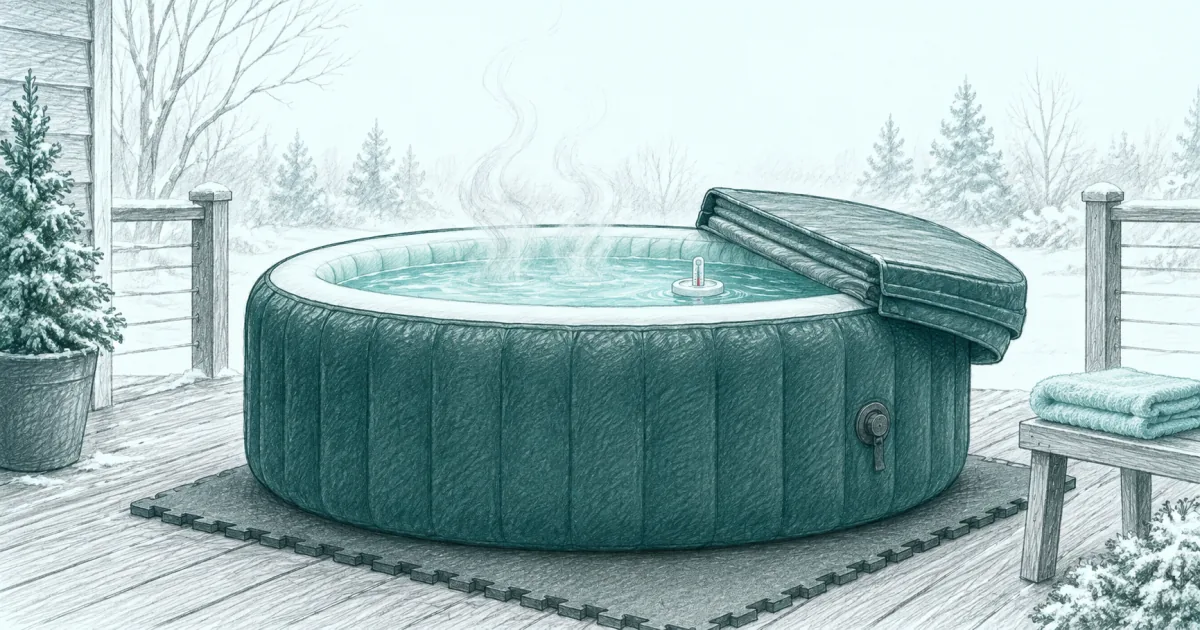
Best Inflatable Hot Tub for Cold Weather (2026): 2 Picks
Hot tubs
The best inflatable hot tub for cold weather is the Coleman SaluSpa Miami for two to four people. The Coleman SaluSpa Sicily is the pick for a bigger family that wants more room and app control.
Our picks
An inflatable hot tub can absolutely run through cold weather, but only the ones built with freeze protection and a real insulated cover do it without drama. The Coleman SaluSpa Miami covers a small patio, and the SaluSpa Sicily is the same platform scaled up for a family.
The difference between a fun winter soak and a ruined pump comes down to three things. The tub needs a heater that cycles to keep the water and plumbing above freezing. It needs a cover that stays on and keeps heat in. And it needs a surface that does not pull warmth straight into cold concrete.
This is the first guide in the new hot tub and spa section, and it pairs with the pool heating guides, including the electric pool heater and pool heat pump pages. If you are still deciding between a spa and a pool heater, those cover the bigger water. The two picks below are for a plug-in spa you can move.
What makes an inflatable hot tub work in cold weather
Cold weather is hard on an inflatable spa for two reasons: the water loses heat faster, and the pump and plumbing can freeze.
Freeze protection is the first feature to check. On Coleman SaluSpa models this is called Freeze Shield, and it cycles the heater when internal temperatures get close to freezing, so the pump and liner are protected even when you are not soaking. That feature is why these tubs can stay up in winter while a basic inflatable cannot.
Insulation is the second. An insulated cover and insulated walls slow heat loss, which is the difference between a tub that holds 100 degrees overnight and one that drops into the 80s. The EnergySense covers on these models are rated as much more efficient than a standard cover.
The last piece is the ground. A tub sitting on cold concrete loses heat into it all night. A foam mat or insulated pad under the shell is a cheap addition that pays back over a winter.
Best overall: Coleman SaluSpa Miami
The Coleman SaluSpa Miami Energy-Efficient AirJet is the best cold-weather inflatable for most yards. It is a 71 inch round tub for two to four adults, with 120 bubble jets, a multi-function pump that inflates, heats, and filters, and Freeze Shield protection built into the platform.
The details that matter in winter are the ones the brand leads with. The insulated walls and cover are sold as up to 40 percent more efficient than a similar inflatable, which shows up as less heat loss overnight. The timer can hold a set temperature weeks ahead, so you are not reheating cold water every evening.
Setup is genuinely quick. The same pump inflates the shell, and a garden hose fills it. The wait is the heat-up, not the assembly. Plan on filling early in the day and soaking at night, and keep the cover on while it climbs.
Buy it if you have a small patio or deck, you want a spa for two to four people, and you want freeze protection without a permanent install. Skip it if you regularly host a bigger group, or if you want a tub you never have to top up with air.
Best for a crowd: Coleman SaluSpa Sicily
The Coleman SaluSpa Sicily Energy-Efficient is the cold-weather pick for a family or a couple who host. It is an 85 inch round shell rated for five to seven adults, with 180 bubble jets and a 314 gallon capacity, so there is room to move.
It runs the same cold-weather hardware as the Miami. Freeze Shield protects the pump and liner, and the EnergySense insulation wraps the walls and cover. What the Sicily adds is app control for temperature, timers, and the jet system, which is handy when you want to warm the water before you walk outside.
The tradeoff is the size. More water means a longer first heat-up and a little more air to keep topped up. If your winters are mild and your guest list is short, the Miami is the easier tub to own.
Buy it if you want a hot tub that fits a group and you like controlling it from your phone. Skip it if you have a small space, or you would rather not wait on a bigger body of water to heat.
What a winter soak actually costs
Nobody should be surprised by the winter power bill, so here is the honest version.
Running an inflatable hot tub costs more in winter than summer, because the heater runs more to hold the same temperature against colder air. Owners commonly report winter running costs that are roughly double to triple the summer figure, and a deep freeze pushes it higher still.
Two upgrades change that number more than anything else. An insulated cover that stays on when the tub is idle cuts heat loss, and a mat under the shell stops the ground from pulling warmth out of the floor. Together they let the heater work less for the same soak.
Keep the water around 95 to 100 degrees between uses rather than letting it cool. Reheating from cold takes many hours. Holding a warm baseline costs less than one long reheating cycle.
Setup tips for a cold-weather hot tub
A few small habits make the difference between a tub you use all winter and one you give up on.
Set it on a solid, flat surface. A full tub is very heavy, and a soft or uneven base stresses the floor and the seams. A patio, deck, or compacted pad is the right home.
Add a mat underneath. Foam or an insulated pad slows heat loss into the ground and protects the vinyl. This is the single cheapest winter upgrade.
Keep the cover on. Between soaks, the cover is what holds the heat. During a freeze, it is also what keeps snow and ice out of the water.
Plan for a power outage. Freeze protection only works while the tub has power. If a long outage hits in a freeze, you need a plan to drain the tub or a way to keep the pump running.
Rinse the filter weekly. A clean filter keeps the heater and jets working properly. A clogged cartridge makes a healthy spa look weak and pushes the heater harder.
Bottom line
Buy the Coleman SaluSpa Miami for a two to four person tub with freeze protection and an insulated cover at a sensible price. Buy the Coleman SaluSpa Sicily if you want a bigger basin, more jets, and app control.
Either way, put it on a solid surface with a mat underneath, keep the cover on, and hold the water near 100 degrees between soaks. That is what makes an inflatable spa a winter habit instead of a summer toy.
Frequently Asked Questions
Do inflatable hot tubs work well in the winter?
Yes, within limits. A tub with freeze protection and an insulated cover can run through mild freezes and into the 20s. Below about 20 degrees Fahrenheit, most makers recommend draining and storing it instead of fighting the cold, and the heater will run almost constantly.
Can I leave an inflatable hot tub out all winter?
You can leave it up and running if it stays plugged in and covered. Freeze protection only works while the tub has power, so an outage in a hard freeze is the real risk. If you cannot guarantee power, drain it, dry it, and store it for the season.
Do Coleman SaluSpa hot tubs have freeze protection?
Yes. Coleman SaluSpa models with Freeze Shield cycle the heater when the water approaches freezing, which keeps the pump and the liner from being damaged. It runs the heater more often in cold weather, so the power bill climbs with the temperature drop.
What temperature should I keep a hot tub at in winter?
Keep it around 95 to 100 degrees between soaks instead of letting it cool to ambient. Reheating cold water takes many hours and more energy than holding a warm baseline. Turn it up a few degrees about three hours before you plan to get in.
Is Coleman or Intex better for cold weather?
Coleman SaluSpa is the safer cold-weather pick because Freeze Shield is built into the platform. Intex PureSpa models heat and filter well, but they do not carry the same freeze protection, and owners are told to drain and store them when temperatures drop.
How much does it cost to run an inflatable hot tub in winter?
Plan on more than summer. Owners report winter running costs roughly double to triple the warm-month cost, depending on your electricity rate and how cold it gets. An insulated cover and a mat under the tub are the two things that move that number the most.
How long does an inflatable hot tub take to heat up in cold weather?
Cold tap water can take close to a day to reach soaking temperature, and longer in a cold snap because the heater is fighting the air. Getting the cover on early, and insulating under the tub, is what shortens the wait the most.
What should I put under an inflatable hot tub?
A flat, solid surface first, then an insulating mat or foam pad. The mat protects the vinyl floor from the ground and slows heat loss into cold concrete or stone. Some owners add a second layer of foam board for winter.