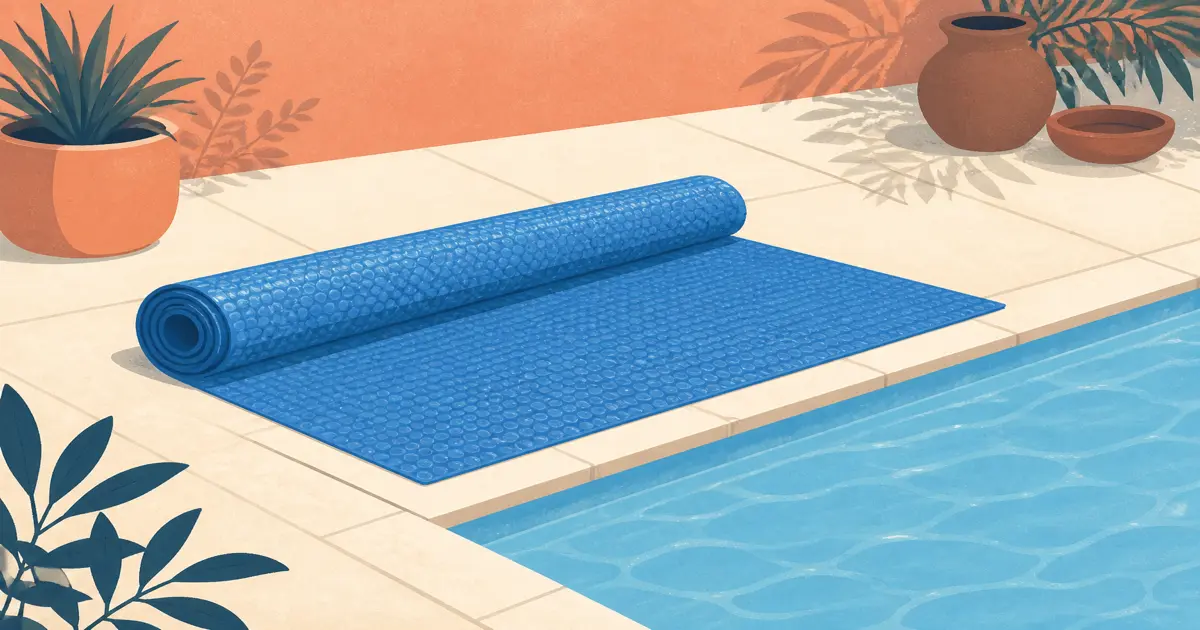
Best Solar Pool Cover (2026): Inground and Rectangle Picks
Accessories
The best solar pool cover for a rectangle or freeform pool is a 16-mil trim-to-fit sheet, and the VEVOR 32x16 is the one to start with. It holds overnight heat, slows evaporation, and trims to stairs and odd corners. For a 15-foot round above-ground pool, the Intex 28013E is the light lift.
Our picks
A solar cover does two jobs: it slows evaporation and it holds heat the sun already put in the water. It is not a heater, and it is not a winter tarp. Once you accept those limits, the choice comes down to thickness, shape, and whether you will actually roll the thing twice a day.
This page covers floating bubble covers for in-ground, rectangle, and freeform pools. More deck gear lives in the accessories section. If surface leaves are still the daily fight, start with the best pool skimmer pillar and come back here for heat.
Which solar pool cover fits your pool?
Coverage is the number to hold in your head. A 32x16 cover is 512 square feet, and at today's prices the VEVOR works out to about $0.29 a square foot at $149.31. The BigXwell is the same 16-mil thickness at $319.99, which is about $0.62 a square foot. You are paying for a stiffer sheet and a longer brand history, not for more plastic.
Which solar pool cover for an above-ground pool?
An above-ground pool wants a cover cut to its own shape, and the tie-down and anchored styles are a different product from a floating bubble sheet. Our best pool cover for above ground guide covers those.
The one exception is the round floating blanket. A 15-foot round above-ground pool takes the Intex 28013E, which is sized to the shell rather than trimmed from a rectangle. If your above-ground pool is round and you only want heat hold, that is the shortcut.
If you have a long oval above-ground pool, do not buy a round blanket and stretch it. Buy a rectangle and trim. An oval cover that does not reach the walls leaves a cold ring at both ends.
Does a solar pool cover actually work?
Yes, for two specific jobs: it slows evaporation and it holds some of the heat the sun already put in the water. It is not a heater. The cover lets sunlight through to the water and traps a layer of warm air against the surface, which reduces the overnight loss that makes morning water feel cold.
The mechanism is simple. Thousands of sealed air pockets sit against the water, and that trapped air insulates the surface the way a blanket insulates a bed. Manufacturers such as VEVOR, BigXwell, and Intex all claim up to 95% evaporation reduction. Treat that as a vendor figure, not an independent test. The evaporation help is the steadier benefit; the temperature gain depends on sun, wind, and how often the cover is actually on.
What does a solar cover save you in water and gas?
A 16 by 32 pool loses about 80 gallons of water a day to evaporation in warm weather, roughly 8,900 gallons over a 16-week season. At the national average of about half a cent a gallon, that is $45 of water, and a cover that cuts the loss by 90 percent gives most of it back.
How the water math works
Pool engineers use the same formula everywhere: gallons per day equals inches lost, divided by 12, times surface area, times 7.48 gallons per cubic foot. At a quarter inch a day on a 512-square-foot pool that is 79.8 gallons a day, 558 gallons a week, and about 8,940 gallons across 16 weeks.
Water is not priced the same everywhere. The national average sits near $0.005 a gallon, but rates run from about $0.0028 in parts of Alabama to $0.0158 in Seattle. The same 8,940 gallons is $25 in one town and $141 in another, so water savings alone pay for a cover in about four seasons where water is cheap and in a little over one where it is not.
What one degree of pool heat costs
A 16 by 32 at an average depth of four feet holds about 15,320 gallons, which weighs 127,760 pounds. Raising that water one degree Fahrenheit takes 127,760 BTUs.
The gas rows carry the same bill because the work is the same: 152,000 BTUs of gas at $1.71 a therm is $2.60 whether the heater is big or small. A bigger heater gets you warm water sooner, not cheaper. A heat pump costs less per degree and heats more slowly in cool air.
That is where the cover pays for itself. If your pool drops two degrees overnight and you reheat it every morning, a cover that holds those two degrees saves about $5.20 a night, or $156 over 30 cool nights. Owners without a heater only see the water savings, which is why the payback story differs so much from one backyard to the next.
Which thickness should you buy?
Match thickness to how often you pull the blanket, and match shape to your pool wall. Most 16 by 32 rectangles want a 16-mil trim-to-fit sheet; most round above-ground kits want a cover sized in feet to the pool.
How do you measure for a solar cover?
Measure the longest span of the water, then add about a foot of overhang so the cover slightly overlaps the wall. For a rectangle, that is length and width at the waterline, not the deck. For a round pool, that is the pool diameter. Order the next size up when you are between two sizes, then trim once.
What does the mil number mean?
Mils are a thickness, not a brand tier. The common ladder is 8 mil as a standard thin cover, 12 mil as the everyday middle, and 16 mil as the thick, heavy-duty sheet. Thicker means more plastic, better overnight insulation, and a longer life in the sun, but it also means a heavier roll onto the reel.
What is the thickest solar pool cover you can buy?
16 mil. That is the top of the off-the-shelf range in most assortments, including the trim-to-fit rolls this page covers. Thicker custom sheets exist but are uncommon and expensive.
Buying 16 mil is not a guarantee of a longer life, though. A 16-mil sheet dragged over concrete every afternoon will fail faster than a 12-mil sheet that lives on a reel in the shade.
Do pool covers let water through?
Yes. A bubble cover is a floating sheet, not a seal. Rain, splash, and overflow pass at the edges, and the perforated bubble film is not a waterproof membrane. That is why the cover slows evaporation without flooding the surrounding area after a storm.
The job it does is evaporation control. A still, warm pool can lose roughly a quarter inch of water a day to evaporation in hot weather. Slowing that is the everyday benefit, and it is the reason owners stop topping off as often.
Top pick: VEVOR 32x16 Solar Pool Cover (16 mil)
Why the VEVOR holds heat better than thin covers
It is cuttable, which matters when your pool has stairs, a vanishing edge cutout, or a slightly odd rectangle. Plan the trim once. Do not nibble it smaller every week. The 16-mil sheet also resists a breeze better than an 8-mil cover, so it does not fold itself up on a windy afternoon.
At $149.31 for 512 square feet it is about $0.29 a square foot, which is the lowest per-square-foot price of the two 16-mil sheets here.
Who should skip the VEVOR
The honest tradeoff is handling. A 16x32 sheet is awkward without a second person or a reel. If nobody will roll it, a thinner cover you actually use is better than a premium sheet that stays in the garage. Pair daily rolls with a best pool cover reel once you use the blanket regularly.
Heavy-duty pick: BigXwell 1600 Series 16x32
The BigXwell 1600 Series 16x32 Solar Cover sits at the same 16-mil thickness and rates 4.5 stars across 1,057 ratings. People notice warmer water for morning swims and less chemical top-off when the blanket stays on between sessions. That is the job: keep heat and water in the shell instead of the air.
When the extra cost makes sense
Choose BigXwell when you want a second trusted 16-mil option at the same size and the price gap does not bother you, or when VEVOR is out of the size you need. Both covers still need clean chemistry under them. A blanket over algae slime only hides the problem.
Store it out of direct sun when it is off the water. Folded plastic left on hot concrete ages faster than a cover that lives on a reel in shade.
Best round: Intex 28013E for 15-foot pools
When the Intex round cover is the right call
The Intex 28013E Solar Cover is the practical answer for 15-foot Easy Set and metal frame pools. It is light, comes with a bag, and covers about 176 square feet. People use it because they can pull it alone before kids jump in. The built-in drain holes keep rain from pooling on top.
Do not buy it for a large in-ground rectangle. The size and thickness are wrong for that job. Also confirm you ordered the diameter that matches your pool. Intex sells multiple round sizes, and the size is easy to skim past in the title.
Expect a shorter life than 16-mil sheets. Budget covers are worth it when they get you through a season of warmer evenings and fewer leaf dumps.
How much warmer does the water get?
Under full sun with the blanket on, most pools gain a few degrees of daytime heat and, more importantly, lose it more slowly overnight. Clear days and calm nights give the biggest bump; cloudy weeks and windy decks shrink it. The evaporation savings are the steadier benefit.
Most fit problems start with an oversized sheet. A cover that is slightly oversized can cup water on top, and a cover left in a hard crease for months can crack along the fold. Trim it once to your outline, leave a small overhang, and store it flat or on a reel.
Keep testing on your normal schedule. Warmer water can use chlorine faster on busy weekends. A kit from best pool test kit still belongs on the shelf.
How do you install and remove a solar cover?
- Brush and skim first so grit is not trapped under the bubbles.
- Float the cover bubble-side down so the air pockets face the water.
- Stretch wrinkles out gently. Do not yank corners like a tarp in a storm.
- Roll toward one end when you swim. Folding wet into hard creases speeds cracks.
- Dry and bag or reel it for long storage.
A cover is not a kid fence. Pull it fully off before anyone enters the water.
What about winter?
A solar blanket is not a winter cover. It floats, it is not anchored, and it will not hold a snow load or a child. If your complaint is closing the pool for the off-season, you want a pool winter cover plus a pool cover pump to pull standing water off after storms, not another bubble sheet.
A solar cover is still worth keeping for the shoulder months, when nights get cold but the pool is still open. It cuts the overnight loss that makes a swim feel chilly in the morning.
When is a solar cover the wrong buy?
Skip it if you never remove covers, hate handling plastic, or only need winter protection. A true winter cover plus a pump is a different system. Skip it if your heater already keeps setpoints cheaply and you only wanted debris control. A robot or vacuum handles debris better than a bubble sheet. If debris is the job instead, start with best robotic pool cleaner.
Buy the cover when your complaint is cool water after sundown, heavy evaporation, or both, and you will put the blanket back on after every swim. If you want active panel heating instead of heat hold alone, switch to a pool solar heater and keep the blanket for overnight.
Bottom line
For most US rectangle pools, the VEVOR 32x16 Solar Pool Cover (16 mil) is the best solar pool cover to buy first at about $0.29 a square foot. Keep BigXwell 1600 Series 16x32 as the heavy-duty alternate if you want the stiffer sheet, and expect to pay about twice as much per square foot for it. Choose the Intex 28013E only when you own a matching 15-foot round above-ground pool and need a light daily lift.
Frequently Asked Questions
What is the best solar pool cover for most homeowners?
For a rectangle pool, start with a 16-mil trim-to-fit sheet like the VEVOR 32x16 Solar Pool Cover. It balances heat hold, evaporation control, and thickness better than thin bubble film.
Do solar covers actually warm the water?
They help on sunny days by trapping heat in the bubble layer and slowing overnight loss. Expect a few warmer degrees over clear stretches, not spa temperatures overnight in cool weather.
Should I buy 12-mil or 16-mil?
Choose 16-mil when you want longer life and better overnight insulation. Choose a thin cover when the pool is small and you will remove it every swim. 12-mil is the middle of the range and the volume seller.
What is the thickest solar pool cover you can buy?
16 mil is the thickest off-the-shelf thickness in most assortments, and it is what trim-to-fit rolls top out at. Thicker custom sheets exist but are rare. 8-mil and 12-mil covers are far more common.
Is a blue or clear solar pool cover better?
Clear passes the most light for heat gain. Blue is the middle choice and the most common. Dark or opaque film blocks light almost completely, which cuts algae growth but also cuts the warming. Pick clear for heat, blue for a balance, dark if the pool sits in full sun and greens up easily.
What thickness pool solar cover is best?
Match thickness to how often you pull the blanket. 8-mil is fine for a small round pool that lifts off every swim. 12-mil is the everyday pick for medium rectangles. 16-mil is the heavier blanket that holds overnight heat better and survives more seasons in the sun.
Do pool covers let water through?
A bubble cover does not seal the pool. Rain, splash, and overflow still pass at the edges and through the perforations. What it does is slow evaporation, which is where most of your water loss actually goes.
Can I cut a rectangular cover for a freeform pool?
Yes. Lay it bubble-side down, mark the outline with chalk, and trim with sharp scissors. Leave a little overhang so wind does not peel the edge.
Is a solar cover a safety cover?
No. It will not support a person or pet. Keep kids supervised and store the cover off the water when anyone is swimming. For deck-anchor safety sheets, see safety pool cover.
What is the best liquid solar pool cover?
Liquid solar covers are surfactants you add to the water that spread a thin film across the surface to slow evaporation. Two common ones, Natural Chemistry Cover Free and AquaDoc Heat Lock, run $22 to $26 a quart. They help a little with water loss and almost nothing with heat gain. A physical bubble blanket beats liquid cover on everything except ease of use.
How do I keep the cover from becoming a leaf trap?
Skim before you pull the blanket, and roll it onto a reel or tarp instead of dragging the dirty side over the deck. Pair it with a net from best pool skimmer.
Do I need a reel with a solar cover?
Not on day one for a small round cover. For a full 16x32 rectangle, a reel or a second person makes daily use realistic. See best pool cover reel if rolling is the pain point.