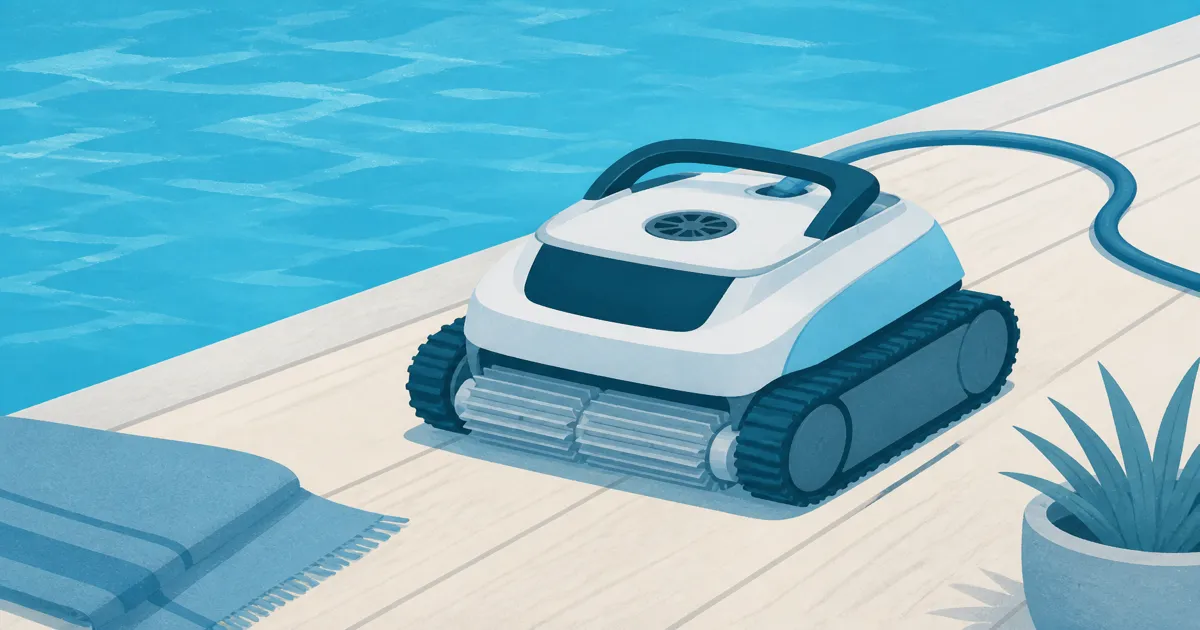
Best Robotic Pool Cleaner (2026): Dolphin Proteus DX3 for In-Ground Pools
Robotic cleaners
The best robotic pool cleaner for most in-ground pools is the Dolphin Proteus DX3 because it climbs walls and scrubs without a battery to charge. Choose the WYBOT C1 for cordless coverage or the Dolphin Nautilus AG for above-ground floors.
Our picks
The best robotic pool cleaner is the one that covers the surfaces you actually hate cleaning. Floor grit, wall film, and the waterline ring are three different jobs. A floor-only robot can leave the walls looking untouched after a two-hour cycle, which is why people decide robots "do not work."
Start with pool type and coverage, then power. A mid-size in-ground pool that grows a film wants a climber. An above-ground vinyl shell that collects sand on the floor often does not. Corded units keep suction until you pull the plug. Cordless units trade that for a clear deck, as long as you charge them and stay inside the rated footprint.
See the robotic cleaners section for the full lineup, or jump to the accessories collection if you already have a robot and need a caddy, cover, or test kit to match.
What should a robot clean, floor, walls, or waterline?
Coverage is the buying decision. Floor means sand, silt, and dead bugs. Floor and walls means the in-ground default. Waterline is the extra most people assume they are getting and are not. Match the coverage to the mess you actually have, then size the robot to the pool.
How do I size a robot to my pool?
Measure the longest dimension first. The Dolphin Proteus DX3 and the Dolphin Nautilus AG are both rated to about 33 ft, while the average US in-ground pool runs closer to 35 ft. That two-foot gap is the quiet reason some owners report missed corners. Cordless units also die mid-cycle on oversized pools, and corded units just wander and leave patches.
Which surfaces can a robot safely scrub?
All four common finishes, if the brushes suit them. Plaster, gunite, fiberglass, and vinyl liner are all fine for the DX3 and the Nautilus AG, and the brushes on the DX3 are soft enough for a vinyl floor. The surface that matters is the waterline tile, which needs a dedicated pad or a waterline-rated machine, not a floor brush pressure-washed against the grout.
Does a robot replace my pump and filter?
No. A robot is a cleaner, not a circulator. The DX3 moves roughly 4,000 gallons per hour through its own basket and runs a two-hour cycle, so one run pushes about 8,000 gallons through the filter. On a 16 by 32 ft pool at an average 5 ft depth, that is around 19,200 gallons of water, so one cycle is roughly 2.4 turns of the pool through the robot. It catches what settles. It does not replace the pump's daily turnover or your chemistry.
Which robot is best for in-ground pools?
The Dolphin Proteus DX3 is the answer for most in-ground pools up to about 33 ft. It is corded, so suction holds for the whole cycle, it climbs common plaster and vinyl finishes, and it empties through a top-load basket. It does not scrub the waterline, so budget one brush pass a week for the tile ring.
Top pick: Dolphin Proteus DX3
The Dolphin Proteus DX3 is the robot to start with on a typical in-ground pool up to about 33 feet. It plugs into a deck power supply, so suction does not fade two hours in. It climbs common plaster and vinyl walls and dumps debris into a top-load basket you rinse at the hose.
Weekly cycles cut the brushing after swim days. The cable is the real ownership tax. On a rectangle it mostly behaves. On a kidney or lagoon shape it can wrap a ladder. Unwind it after a few runs and let it lie straight so it does not learn kinks.
Skip the DX3 if you already know you will never coil a cord, or if the pool is above-ground vinyl and you only need the floor scrubbed. It is also worth knowing that the DX3 ships with standard fine filters only and no finer option, so a pool that goes hazy needs chemistry work rather than more robot.
Best cordless: WYBOT C1
The WYBOT C1 is the cordless pick when you want floor, wall, and waterline coverage without a floating cable. App modes help when you only need a floor pass midweek and a fuller climb on the weekend.
Charge discipline is part of owning it. Empty the filter after muddy cycles and stay inside the rated square footage. The trade against a corded unit is simple. A corded cleaner runs until you pull the plug. A cordless cleaner stops when the battery does, so a mid-cycle stop is a real possibility on a large pool during a heavy leaf week.
Skip the C1 if your pool is much larger than the rating, or if you want set-and-forget power with no charging calendar.
Best above-ground: Dolphin Nautilus AG
The Dolphin Nautilus AG is a plug-in floor scrubber for above-ground pools up to about 33 feet. Floor debris is the main complaint on those shells: sand, pollen, and whatever the wind drops. This robot handles that weekly job without asking you to snake a vacuum hose.
It does not climb walls or wipe the waterline. Plan on a quick brush pass for the ring, same as you would with any floor-only unit. For pools that are shallower and simpler still, the best above-ground pool cleaner guide covers the wider field, and cordless-only buyers can compare in the best cordless pool vacuum guide.
What keeps a robot useful after month one?
Rinse the filter after every cycle, not once a month. Packed debris cooks in chlorine and kills suction. Store the unit out of the pool when idle so seals and bearings are not soaking overnight, and keep the power supply off the ground because most units are water-resistant rather than waterproof.
For corded models, unwind the cable fully after a few runs. For cordless models, charge on a dry mat and keep the port out of standing water. One owner habit worth borrowing: switch the pool pump and return jets off during a robot cycle, because still water lets the robot pick up more instead of chasing debris the returns keep moving.
When does a robot need replacing?
Owners report cable jackets and filter baskets as the common wear items, and several note units failing around the two-year mark rather than the five-to-seven-year range. That is the argument for keeping the filter clean, rinsing after every run, and storing on a caddy. A pool robot caddy keeps the cable, power supply, and cleaner together, which protects the cable jacket from the repeated kink that ends most robots early.
Bottom line
For most in-ground owners, start with the Dolphin Proteus DX3. Move to the WYBOT C1 when cordless climbing and waterline coverage are the priority. Keep the Dolphin Nautilus AG for above-ground floor duty. Match coverage to the mess you actually have, then keep the filter clean so the cycle you paid for still happens.
Frequently Asked Questions
Which robotic pool cleaner is best for in-ground pools?
The Dolphin Proteus DX3 is the safest starting pick for most in-ground pools up to about 33 ft. It climbs walls, scrubs the floor, and runs from a low-voltage power supply so suction does not fade mid-cycle. Move up to a unit with waterline cleaning if the tile ring is your main complaint.
Which robotic pool cleaner is best for above-ground pools?
The Dolphin Nautilus AG is built for above-ground shells up to about 33 ft. It scrubs the floor, has a top-load filter basket, and does not need a power supply hung at deck height. Skip wall climbing on an above-ground pool because most shells do not need it. A brush pass for the waterline is still part of the job.
Are cordless robotic pool cleaners as good as corded?
Cordless units like the WYBOT C1 now climb walls and scrub the waterline, which used to be a corded-only feature. The trade is charge discipline and runtime. A corded cleaner runs until you pull the plug. A cordless cleaner stops when the battery does, so a mid-cycle stop is a real possibility on a large pool during a leaf week.
How long do robotic pool cleaners last?
Most residential robots last about 5 to 7 years with regular filter cleaning, fresh-water rinses, and dry storage between seasons. Cheap brushes, sealed batteries, and worn cables shorten that window. A caddy and a covered patio help the longer end of the range by protecting the cable jacket and the power supply.
How much does a robotic pool cleaner cost to run?
Very little. A two-motor robot drawing roughly 180 watts for a two-hour cycle uses about 0.36 kWh, which lands near 6 cents at a national average of about $0.17 per kWh. Over a 6-month season of three cycles a week that is under $5 of electricity, so the robot purchase, not the power bill, is the real cost.
Can a robot clear cloudy water or algae?
No. A robot moves settled debris and a light film, but it does not fix green or hazy water. Balance chlorine and pH first with a kit from our best pool test kit guide, brush the walls to break the algae loose, then run the robot to clear the floor. A robot alone will not clear an algae bloom.
Do robotic pool cleaners clean the waterline?
Only some. The Dolphin Proteus DX3 climbs walls but does not scrub the waterline, so the tile ring still needs a brush or a pad. Cordless units like the WYBOT C1 do reach the waterline, and higher-end corded models add it too. If that ring is your real complaint, buy for waterline coverage rather than floor power.
Can you leave a robotic pool cleaner in the pool?
Leaving it in the water shortens seal life, stresses the cable, and lets chlorinated water sit against plastic. Pull the robot out after each cycle, rinse the filter basket, and let it dry on a caddy or shelf before the next run. Storing the robot on a pool robot caddy keeps the cable from kinking at the same spot.
Are robotic pool cleaners worth the money?
For most in-ground pools, yes. A robot saves the weekly manual vacuuming and runs on a low-voltage power supply. They are less worth it for small above-ground pools that can be netted in 10 minutes, or for owners who already have a reliable suction-side cleaner. See our best pool vacuum guide for that side of the kit.