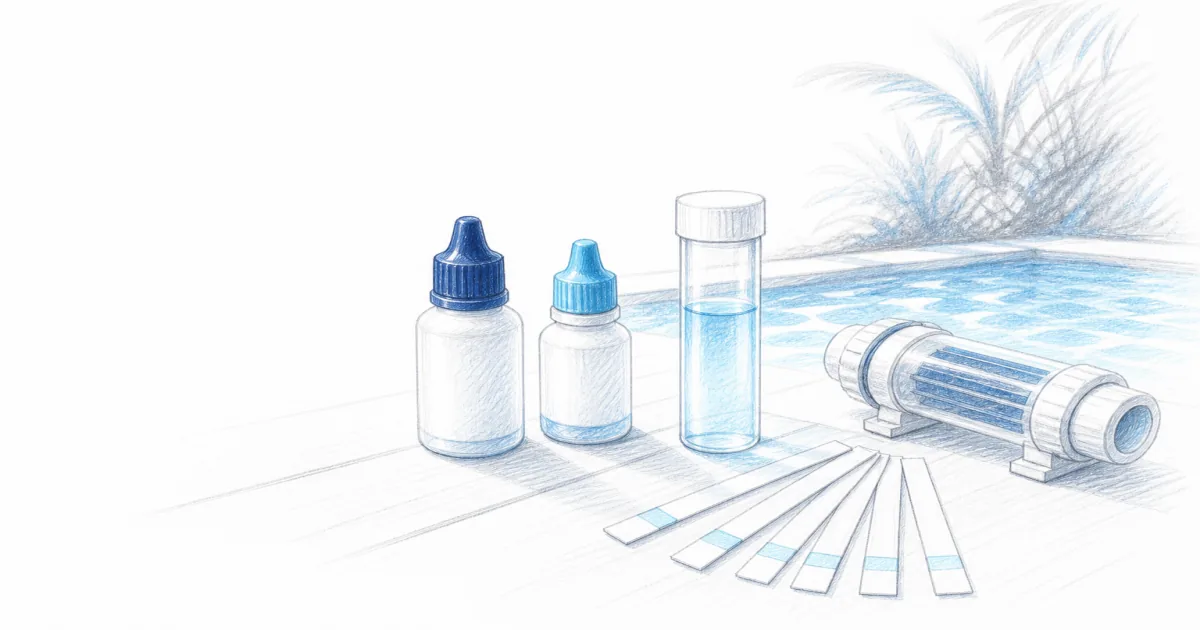
Best Saltwater Pool Test Kit (2026): Taylor Drop Salt + Quick Strips
Water care
Saltwater pools still need chlorine and balance tests, plus a real salt reading. Use Taylor drops when the generator disagrees with a strip.
Our picks
A saltwater pool is still a chlorine pool. The cell turns salt into sanitizer, so you still need free chlorine, pH, and alkalinity on a normal cadence. The extra job is salinity: too low and the cell starves, too high and you chase balance problems you did not need.
This guide owns the salt-specific kit decision. For general strips and drop kits, use our best pool test kit guide. For strip-only salt habits, see pool salt test strips. More water-care posts live in the water care section.
What a saltwater kit has to cover
You are buying two layers of truth:
- Salt (sodium chloride) so the generator can make chlorine.
- Normal pool chemistry so swimmers are not sitting in unbalanced water.
The Taylor K-1766 handles layer one well. It does not replace a FAS-DPD chlorine kit. Owners who only buy salt tools still end up guessing on acid and alkalinity.
Salt drop kit: Taylor K-1766
The Taylor Technologies K-1766 Sodium Chloride Drop Test Kit is the kit most careful saltwater owners keep for the money decision. You titrate chloride, count drops, and get a number you can compare to your cell’s target range.
It is slower than a strip. That is the point. When the display says 2,800 ppm and a strip looks “fine,” the drop kit is how you decide whether to buy pool salt or clean the cell instead.
Work in shade, follow the reagent order on the booklet, and replace expired bottles. A heat-soaked reagent set lies louder than a tired strip bottle.
Midweek salt strips: AquaChek
AquaChek Salt Test Strip Titrators are the easy midweek companion. Dip, wait for the white peak, read the scale. They are best for directional checks after a storm, a long party weekend, or a backwash that dumped a lot of water.
Do not treat a single strip as a final shopping list. If the strip and the cell disagree by a wide margin, run the Taylor kit before you open bags.
How to use the kit without chasing ghosts
Test after the pump has run. Grab water from elbow depth away from returns. Rinse the vial with pool water first.
Write the number down next to the cell reading and the date. Patterns matter more than one dramatic afternoon. If salt keeps falling with no splash-out story, look for leaks or heavy dilution, not a broken test method.
When free chlorine will not hold even though salt looks right, brush, filter, and check balance. Algae and organics eat chlorine. See pool algaecide only after sanitizer and circulation are honest.
Who should skip a dedicated salt kit
If you have a plain chlorine or bromine pool with no salt cell, skip this page. You want a standard test setup from the best pool test kit guide.
If a pool company already tests salinity every visit and you never adjust salt yourself, strips may be enough for peace of mind. Buy the Taylor kit the first time you plan to dose salt without a tech on site.
Pair salt testing with the rest of the system
Salt bags only help when the cell is sized and installed correctly. Our salt water chlorinator guide covers cell sizing. Keep CYA and calcium in range so the water does not fight every adjustment.
Clear water still needs debris removal. Skim first, then let filtration polish. Chemistry cannot scoop leaves.
Browse sibling guides on the blog or start from the homepage at Poolsidebasics when you are mapping a full season kit.
Frequently Asked Questions
What's the best saltwater test kit?
For most homeowners, the Taylor K-1766 is the best saltwater pool test kit for salt decisions. Keep AquaChek Salt Test Strip Titrators for quick midweek checks, and use a full drop kit from our best pool test kit guide for chlorine, pH, and alkalinity.
Do you need a special test kit for a salt water pool?
Yes for salinity. Salt systems still need normal chlorine and balance testing, plus a dedicated salt method. Generic “6-way” strips often skip salt or treat it as a rough pad.
Which Taylor test kit is best for a saltwater pool?
Use the K-1766 for sodium chloride. Pair it with a Taylor FAS-DPD kit like the K-2006 when you need free chlorine and balance numbers, not just salt.
What test kits are available for saltwater pools?
Drop kits (Taylor K-1766), salt strip titrators (AquaChek), and some digital salinity meters. Drops win when the cell display and a strip disagree.
Can I trust my salt chlorinator’s built-in reading?
Treat it as a clue, not gospel. Cells drift with scale, temperature, and age. Confirm with a home kit before you dump several bags of pool salt.
How often should I test salt?
After opening, after heavy rain or backwashing losses, and whenever the salt water chlorinator output looks odd. Weekly midweek strips are enough for many stable pools.
Do saltwater pools still need chlorine test strips or drops?
Yes. The cell makes chlorine from salt. You still measure free chlorine, pH, alkalinity, and CYA like any other pool.
When should I skip strips and go straight to drops?
When you are about to buy salt, lower output, or call a tech. Money and service calls deserve the Taylor count.