Pool Check Valve (2026): Straight 7305 vs 90° 7511
Accessories
A pool check valve stops reverse flow that drains heaters, loses pump prime, or sends water the wrong way on the pad. Match straight vs 90-degree and the pipe size stamped on your fittings.
Our picks
A pool check valve is a one-way gate on the equipment pad. Water should move toward the filter, heater, or returns. When the pump stops, reverse flow can drain a heater, empty a solar loop, or make the pump fight for prime on the next start.
It is not a multiport valve. Multiports choose filter modes. Check valves only stop backflow. Browse accessories for more pad hardware, and keep pressure readings honest with a filter pressure gauge. More guides live on the blog, and the homepage maps the rest of the site.
Straight vs 90-degree at a glance
Measure before you order. The wrong angle forces extra elbows. The wrong size means you cut pipe twice.
Straight run: Jandy 7305
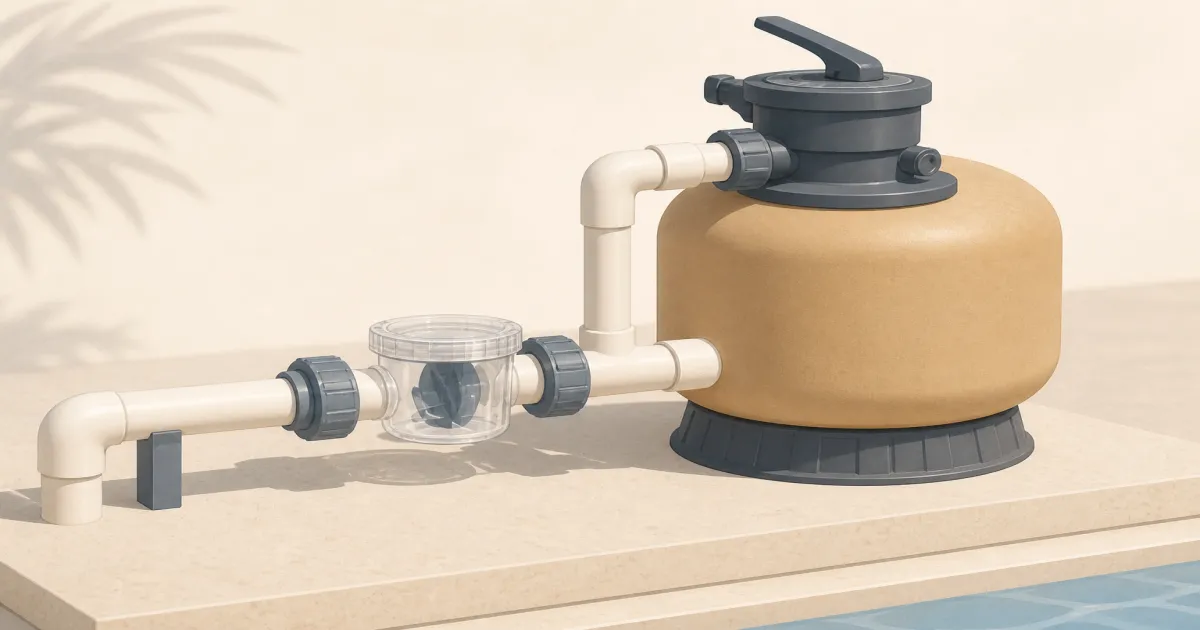
The Jandy 7305 is the classic straight check for 2-inch to 2-1/2-inch plumbing. The clear lid lets you see whether the flapper is free or packed with debris. That matters after a sand blowback or a season of calcium flakes.
Owners like it because the swing opens with little resistance when the pump is on, then seats when flow reverses. Install with the arrow pointing in the normal flow direction. Glue or union it so you can service the lid without destroying the whole run.
Skip the 7305 when the pad geometry needs a corner. Forcing a straight body into a 90-degree path just adds fittings and leak points.
90-degree pad: Jandy 7511
The Jandy 7511 is the better buy when space is tight and the pipe already turns. It covers 1-1/2-inch to 2-inch sizes, so confirm your fittings before you assume it matches a 2-1/2-inch manifold.
Same clear-lid idea as the 7305. Same rule about flow arrows. The advantage is the layout: one molded 90-degree body instead of a straight valve plus an elbow.
Skip the 7511 if your existing valve is clearly a 2 to 2-1/2 inch straight pattern. Pipe size mismatches show up as leaks and restricted flow, not as a “close enough” install.
Where check valves earn their keep
Common homes for a pool check valve:
- Before a gas pool heater or heat pump so water does not drain backward when the pump stops
- On spa or solar loops that sit higher than the pad
- Anywhere reverse flow has already cost you prime on a variable speed pool pump
If the symptom is sand in the pool after backwash, look at multiport seating and laterals first. A check valve will not fix a multiport that bypasses to waste on the wrong handle position.
Install and care notes
Shut the pump off and relieve pressure before you open a lid. Clean the flapper seat. Replace cracked lids and tired springs instead of wrapping them in tape. After install, run the pump and watch for weep at joints, then shut it down and confirm the heater or elevated loop is not draining backward.
Keep chemistry reasonable. Aggressive water shortens seals. A pressure gauge nearby helps you notice when something on the pad is restricting flow after the swap.
How to size and replace without guessing
Take a photo of the old valve before you cut anything. Note the arrow direction, the pipe size markings, and whether the body is straight or 90-degree. If unions are present, loosen them and pull the valve as a unit. If the valve is solvent-welded, you will cut back to clean pipe and dry-fit the new body before gluing.
Do not mix pipe sizes to “make it work.” A 2-inch valve on a 1-1/2-inch run needs the correct adapters, not a forced fit. The same goes for 2-1/2-inch manifolds. When the listing says 2 to 2-1/2 inch, it means that family of fittings, not every PVC diameter on the pad.
After the glue cures for the labeled time, start the pump on a low speed if you have a variable speed pool pump. Watch the clear lid. The flapper should lift cleanly with flow and drop when you shut the pump down. If it chatters or stays half open, debris or a weak spring is still in play.
Troubleshooting reverse-flow symptoms
A noisy pump after a valve swap is often air or a flapper that never fully opens. Shut down, open the lid, and confirm the swing path is clear. Do not keep running a pump against a stuck check. That is how seals and motors get abused.
If sand shows up in the pool after backwash, fix the multiport first. A check valve will not stop a multiport that is bypassing media on the wrong handle position.
Bottom line
Match the pool check valve to pipe size and angle first. The Jandy 7305 owns straight 2 to 2-1/2 inch runs. The Jandy 7511 owns 90-degree 1-1/2 to 2 inch pads. Point the arrow with flow, keep the lid clearable, and leave multiport jobs to the multiport.
Frequently Asked Questions
What does a pool check valve do?
It allows flow in one direction and closes when water tries to reverse. That protects heaters, helps hold pump prime, and keeps spa or solar loops from draining the wrong way.
Is a check valve the same as a multiport valve?
No. A multiport valve chooses filter modes like backwash and rinse. A pool check valve only blocks reverse flow.
Straight or 90-degree?
Match the body to the pipe path. Straight (7305) for in-line runs. 90-degree (7511) when the pad turns a corner and you want fewer elbows.
What size do I buy?
Read the markings on the existing valve or measure the pipe OD and fittings. 2 to 2-1/2 inch and 1-1/2 to 2 inch are not interchangeable.
Why is my flapper stuck open?
Debris, scale, or a weak spring can hold it. Shut the system down, open the clear lid, clean the seat, and replace worn internals if the flap will not seal.
Can I install it myself?
Many owners swap a like-for-like valve with unions or solvent welds. If you are cutting into pressurized lines or heater loops, a pool tech is cheaper than a flooded pad.
Which way does the arrow face?
Flow direction arrow points with normal pump flow. Install it backward and the valve fights the pump.