Best Pool Pump Motor (2026): 56Y and 56J Replacement Picks
Accessories
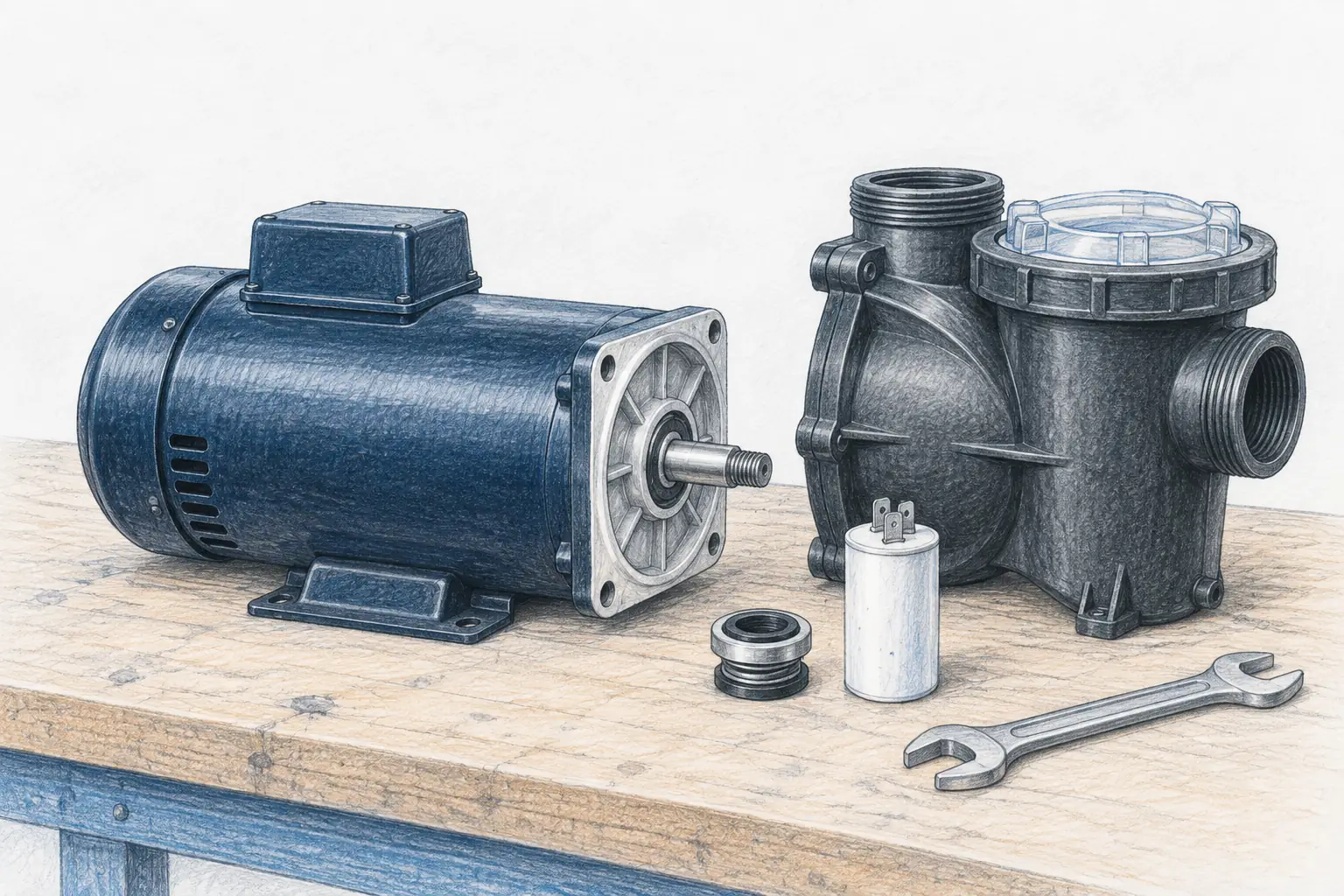
The best pool pump motor for most owners is a 56Y or 56J replacement matched to the old motor's frame and voltage. The VEVOR 2 HP 56Y is the value pick for a square-flange wet end, and the Century UST1152 is the round-flange standard.
Our picks
A pool pump motor is the part that fails first. The plastic wet end and the impeller usually outlast the motor, so when the pump starts tripping the breaker, humming, or grinding, you are often buying one part rather than a whole new pump. That repair costs a fraction of a replacement and keeps your plumbing untouched.
This guide sits in the accessories section with the rest of the pad equipment. If the whole pump is done, start with our best pool pump guide instead, and use this page only when the housing is worth saving.
The entire decision comes down to fit. Get the frame code, the horsepower, and the voltage right, and the swap is a straightforward afternoon.
Match the motor before you shop
Four numbers decide whether a motor bolts on and runs.
Frame code. 56J is a round flange with a threaded shaft. 56Y is a square flange that bolts through a face plate. These are not interchangeable, so identify yours first.
Horsepower and total horsepower. A 1.5 HP motor with a 1.1 service factor delivers about 1.65 total horsepower. Two motors with the same label HP can move different water, so copy the nameplate rather than rounding up.
Voltage. Single-speed pool motors commonly run 115V or 230V, and many are switchable. Match your supply and confirm the setting inside the rear cover before the first start.
Rotation and capacitor. Swim pool motors typically turn counterclockwise and use a specific run capacitor, often around 50 microfarads at 250V. The new motor's label should name both.
Best square flange: VEVOR 2 HP 56Y
The VEVOR 2 HP 56Y Pool Pump Motor is the value pick when your wet end takes a square flange. It is a single-speed, 230V motor rated at 3450 RPM with a 1.3 service factor, and the 56Y face matches a wide range of common housings.
Two details make the install easier. The rotation is counterclockwise, which is the standard for this class, and the capacitor is a common 50 microfarad part you can find locally if it ever fails. The steel housing is built for an outdoor pad rather than a garage shelf.
Buy it if you have a 56Y wet end in good shape and want the repair done for a few hundred dollars instead of a full pump swap. Skip it if your housing is cracked, because a new motor on a failing wet end will not last.
Best for name-brand wet ends: Aquastrong 56Y
The Aquastrong Pool Pump Motor is the pick when you are repairing a Pentair or Sta-Rite pump rather than an unknown one. It is a 56Y square-flange, single-speed motor rated 2 HP and 230V at 3450 RPM, with 2.2 total horsepower and a 1.1 service factor.
The value here is fit confidence. Aquastrong lists compatibility with several common pump families, including Pentair Challenger, Pinnacle, and WhisperFlo, and the Sta-Rite Max-E-Glas and Dura-Glas lines. If your pump is on that list, the mounting dimensions and shaft are meant to line up.
Buy it if you know your pump model and want a motor built around it. Skip it if you have not confirmed the frame, because a square flange will not fit a round-flange housing.
Best round flange: Century UST1152
The Century Electric UST1152 is the round-flange standard for a reason. It is a 1.5 HP, single-speed, up-rated motor on a 56J round flange with a threaded shaft, and it is a direct fit for a long list of common Hayward and Sta-Rite wet ends.
It runs on 115V or 230V with a switch inside the rear cover, and the corrosion-resistant shell holds up on an outdoor pad. Owners consistently report two things: it is quieter than the motor it replaced, and it needs a new shaft seal at the same time. Both are true of every motor on this page.
Buy it if you have a round-flange pump and want the well-known replacement. Skip it if your housing is a square-flange 56Y, because the flange will not seat.
Order these in the same click
A motor alone rarely finishes the job. Add these before you start, so the pump is not sitting open while you wait on a package.
A shaft seal kit. The seal, the housing gaskets, and often the o-rings come as a set. Replace all of them at once. This is the single step that decides whether the new motor lasts years or a season.
A slinger. A small rubber ring that rides the shaft behind the seal and throws water away from the bearing. It is cheap and easy to forget, and owners who skipped it often reopen the pump later to add one.
New mounting hardware. Bolts and washers that have been wet for years round off or snap. Match the thread and length to your housing.
A motor cover or a shaded pad spot. Rust along the bottom edge is a common end for motors in humid climates. Keeping rain off the shell is cheap insurance.
When to hire it out instead
The swap is within reach for most owners. Four bolts, three wires, a seal, and a rewire is the whole job, and it takes a practiced hand under an hour. If you are comfortable turning off the breaker and matching wires by color, you can do it.
Hire an electrician or a pool tech if the wiring is not clearly labeled, if the circuit is not a GFCI-protected pool circuit, or if the pump is bonded in a way you do not recognize. Bonding and grounding are safety items, not optional steps, and this is the one part of the job where guessing is a bad trade.
Hire a tech for the whole job if your plumbing has no unions and the pump cannot come out without cutting pipe. That turns a one-hour repair into a plumbing project, and the labor math changes.
Bottom line
Match the frame first, then the horsepower and voltage. For a square-flange wet end, the VEVOR 2 HP 56Y Pool Pump Motor is the best pool pump motor value, and the Aquastrong 2 HP is the confident fit for Pentair and Sta-Rite housings. For a round-flange Hayward-style pump, the Century UST1152 is the standard replacement. Buy the seal kit in the same order, confirm the voltage setting before the first start, and the repair will cost far less than a new pump.
Frequently Asked Questions
How do I know which pool pump motor to buy?
Match the old motor's nameplate, not the pump's marketing name. You need the frame code (56J round flange or 56Y square flange), the horsepower and total horsepower, the voltage, the rotation direction, and the capacitor rating. A motor with the wrong frame will not bolt up, no matter how close the horsepower looks.
What is the difference between 56J and 56Y frames?
56J uses a round flange and a threaded shaft, and it shows up on many Hayward and Sta-Rite pumps. 56Y uses a square flange and bolts through a face plate, which is common on Pentair and other equipment. Measure your old motor and count the bolt pattern before ordering.
Do I need a new seal when I replace the motor?
Yes. Replace the shaft seal and the housing gaskets every time the motor comes off. The seal is the part that failed and let water reach the front bearing in the first place. Reusing an old seal is the fastest way to kill a new motor.
Why does a new motor hum and not start?
Check the voltage setting first. Many motors ship set for one voltage, and running a 115V motor on 230V will damage it while a 230V motor on a 115V line will only hum. Open the rear cover and confirm the plug position matches your supply before you power up.
Can I replace just the motor instead of the whole pump?
Usually yes, and it is the cheaper repair. If the plastic wet end, the diffuser, and the impeller are sound, a new motor restores the pump for far less than a full replacement. If the housing is cracked or the impeller is chewed up, replace the pump instead.
Is a two-speed or variable-speed motor a better upgrade?
Sometimes. A variable-speed motor cuts run cost and noise, but it needs a controller or a drive and may not fit an older wet end. If your goal is simply to get the pump running again at the lowest cost, a single-speed drop-in is the simpler fix.