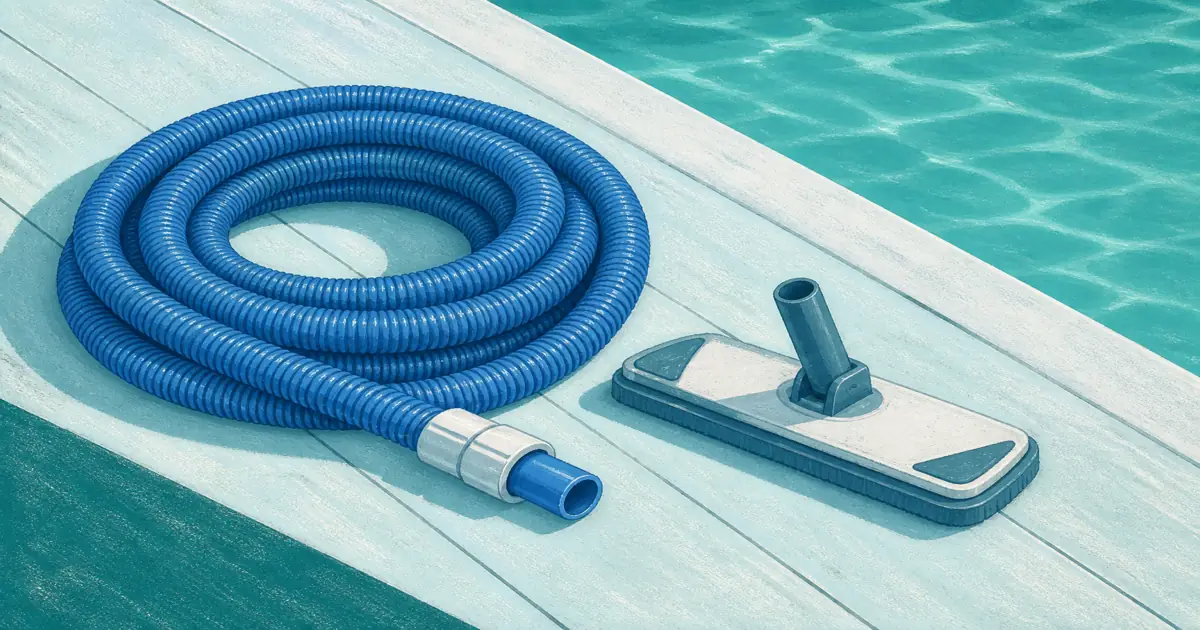
Pool Vacuum Hose (2026): Size Chart, Fittings, and Kink Fixes
Vacuums
Match hose diameter to the vacuum head and skimmer cuff using a pool vacuum hose size chart, then buy enough length to reach the deep end. If the coil collapses, the problem is usually pump suction, not the hose.
Our picks
A pool vacuum hose is a boring part until the wrong one ruins Saturday. Too narrow, and the cuff will not seal. Too short, and you cannot reach the main drain. Too long, and you fight coils that suck air at the skimmer.
Hoses sit in the vacuums section with heads, plates, and canisters for suction-side work. Start from the best pool vacuum pillar if you have not picked the vacuum itself yet.
This page is the fit check. Hero pick first, then the above-ground alternative in plain language. The specs here come from the product listings, and the fixes come from owner threads.
What size pool vacuum hose do I need?
Match the inside diameter of the cuff to your vacuum head and skimmer, then buy enough length to reach the deep end with a couple of feet of slack. In-ground gear is usually 1.5 inches; above-ground gear is usually 1.25 inches.
Measure the cuff, not the coil
Pull the old hose off the vacuum head. Measure the inside of the cuff, not the coil.
Which diameter is which?
1.5 inches is the in-ground default. It matches most manual vacuum heads and many skimmer plates. 1.25 inches is the above-ground default; those filter pumps and vac heads are built around the smaller hose.
If you force a 1.5-inch hose onto a 1.25-inch skimmer, you will leak air and lose suction. If you jam a 1.25-inch hose into 1.5-inch in-ground gear, the seal will be sloppy. Buy the diameter that matches the parts you already own.
Pool vacuum hose size chart
The size chart on the box usually lists inside diameter, length, and cuff type. Here is the working version for the common residential hoses you will find on Amazon.
The two columns that decide a hose are diameter and length. Diameter has to match the cuff on your vacuum head and skimmer. Length has to reach the deep end of your pool with a few feet of slack. Pick both, then look at cuff type and brand.
Swivel cuffs are worth the small upcharge for any hose over 18 feet. The swivel lets you turn the pole without twisting the hose into a kink. A non-swivel cuff on a long hose is a Saturday of fighting coils.
Are all pool vacuum hoses the same?
The short answer is no, but the difference is not where most people look.
Hoses vary in diameter, length, cuff style, and wall thickness. It is tempting to think a thicker wall will fix every problem. Owners who went down that road bought hose after hose, including the heaviest they could find, and still watched the coil collapse the moment the pump pulled hard.
The real cause is suction balance. If your pump is pulling more water than the hose and head can pass, the pressure difference crushes the hose walls inward. A stiffer hose fights it longer, but the fix is on the valve, not in the box.
So a hose is not a hose. A 1.25-inch economy coil for a compact above-ground pool is a completely different part from a 1.5-inch spiral-wound hose for an in-ground deep end. Buy the shape that matches your pool and your pump, not the one with the thickest wall.
What you hook a pool vacuum hose to
One end of the hose goes to the vacuum head. The other end goes to a water source, and it sets the diameter you need.
Skimmer plate
The most common setup. The plate seats over the skimmer basket opening, and the hose cuff pushes into the plate. It is simple and it uses parts you already own.
Dedicated vacuum port
Some pools have a wall fitting made for a vacuum hose. It skips the skimmer entirely and often gives stronger suction, which is also why it is the setup most likely to collapse a light hose.
Skimmer intake through the basket
On some above-ground pools the vacuum hose drops straight into the skimmer basket or a housing adapter. Check that the adapter is seated, because a loose adapter looks exactly like a diameter mismatch.
Whatever the setup, confirm the cuff on both ends before you buy. A hose that fits the head but not the plate is still the wrong hose.
Hose and head belong together
The hose is half of a pair. A head with a 1.25-inch port will not seal on a 1.5-inch hose, no matter how tight you push.
Buy them as a set when you can. The pool vacuum head guide covers the head side, and the pool vacuum plate guide covers the plate that adapts your skimmer. Walk in knowing those two part numbers and the hose becomes the easy call.
Length follows the head. A wide head moves more debris but needs more suction, which is the same balance problem that collapses a thin hose. If you are upgrading the head, plan to check your valve settings on the first run.
Hero pick: Swimline 1.5-inch 30-foot
Why the 1.5-inch 30-foot fits most in-ground pools
The Swimline Hydrotools 1.5-Inch 30-Foot Vacuum Hose is the replacement we would order for a typical in-ground manual vacuum. Thirty feet reaches most backyard deep ends without turning the deck into a garden-hose maze.
The swivel cuff is the useful detail. You can turn the pole and the hose does not immediately twist into a kink. Owner reviews on this size are deep, which matters on a part that lives in sun and chlorine.
Skip this hose if your system is 1.25-inch above-ground. The extra diameter will not magically make a small skimmer happier.
Above-ground alternative: 1.25-inch 18-foot
When the 1.25-inch 18-foot is the better buy
The Swimline Hydrotools 1.25-Inch 18-Foot Vacuum Hose is the better buy for compact above-ground pools. Eighteen feet is enough for most round and oval shells. The smaller diameter matches the cuffs on those vac heads and filter intakes.
If your above-ground pool is long and you keep losing the far wall, step up in length inside the same 1.25-inch family. Do not "solve" that with a 1.5-inch in-ground hose.
Keep the vacuum head underwater while you feed the hose into the skimmer so the line fills with water. Air in a short hose still kills suction.
Why does my hose collapse while I vacuum?
Buy enough hose to reach the farthest corner with a little slack, because stretching a short hose lifts the head and sucks air. If the coil still collapses, the pump is pulling harder than the hose can pass, and a thicker wall will not fix it.
Fix the valve before you buy a thicker hose
If the hose collapses while you work, you are not fighting the hose. You are over-pulling the line. In an owner thread on this exact problem, the fix was not a thicker hose after six tries. It was balancing the suction between the cleaner and the skimmer with a valve, or lowering the pump speed until the coil held its shape.
How to fill the hose before you start
Fill the hose with water before you start vacuuming. The usual method: put the head in the pool, raise the other end to the skimmer, and let water push the air out. Then connect.
Store the hose in a loose coil out of direct sun. A baked, flattened coil will collapse the first time the pump pulls hard.
If you vacuum after storms, empty the best pool skimmer first. Leaves in the hose become plugs, and plugs get blamed on "weak suction."
Where does the air leak come from?
Air in the line is the other half of the suction problem, and it almost always enters at a joint rather than through the hose wall.
Start at the vacuum head and work back. Listen along the assembly for a hiss, and check each connection in turn. Owners who solved a "pool vac sucking air" mystery did it by finding a small leak where the hose met the plate and wrapping it.
The spinning collar is a regular culprit. Many hoses have one end that turns freely and one that does not. If the spinning end sits at the skimmer plate and rides above the waterline, it pulls air the whole session. Flip the hose and the problem goes away.
One last cause is distance. A very long run of pipe plus hose can starve the pump enough that the head stops moving. If suction fades only on a far, long setup, shorten the path before you buy another hose.
When should you not buy a hose?
If you want hands-off weekly cleaning, a hose is the wrong cart. A robotic cleaner filters on board. Start with the best cordless pool vacuum or the broader best pool vacuum guide.
Buy a hose when you already own a manual vacuum head and a working pump. Replace it when the old coil is split, crushed, or no longer holds a seal at the cuff.
A new hose will not fix a dying pump, a clogged impeller, or a skimmer weir that is stuck shut. Check those before you order a second hose.
Quick setup that actually holds suction
Connect the head, fill the hose, then seat the cuff in the skimmer or vac plate. Keep the head on the floor. Walk slowly. Overlap passes the way you would mow a small lawn.
If suction fades, look for an air hiss at the cuff, a kink at the coping, or a full pump basket. Those three cause more "bad hose" returns than the hose itself.
When the session is done, drain the coil and hang it. A hose that sits full of dirty water in the sun smells like a forgotten gym bag, and it dies sooner.
Signs the old hose is done
Replace it when you see splits at the cuff, flattened coils that will not round out, or a hiss of air you can feel with soapy water on the joint. A hose that has been stored in a tight hanging loop often kinks in the same spot every time.
Sun and chlorine make plastic brittle. If the cuff cracks when you twist it onto the head, stop forcing it. That crack is an air leak waiting for the next vacuum session.
Buy one good replacement in the right diameter. Keep the receipt until you confirm suction on your own skimmer. Fit is the whole product. A pool backwash hose is a different part: lay-flat discharge vinyl for filter waste, not a ribbed vacuum line.
If you vacuum once a week in leaf season, inspect the cuff monthly. A hairline split starts as a whistle and ends as a hose full of air. That five-second check is cheaper than another Saturday of "why is this not picking up?"
Frequently Asked Questions
What size pool vacuum hose do I need?
Measure the cuff on your vacuum head and skimmer. Most in-ground gear is 1.5 inches. Many above-ground filter systems are 1.25 inches. Do not guess from a photo.
Are all pool vacuum hoses the same?
No. They differ in diameter, length, cuff type, and wall thickness, but the bigger surprise is that wall thickness is usually not why a hose fails. A hose that collapses or crumples is being squeezed by too much pump suction on the cleaner line, and a thicker hose only hides the problem for a while.
What do you hook a pool vacuum hose to?
Most owners connect the hose to a vacuum head on one end and a skimmer plate, a dedicated vacuum port, or the skimmer intake on the other. The hose itself does not decide the connection. Your vacuum head, skimmer, and plate decide the diameter. Match both ends or the seal will leak air.
Is there a standard pool vacuum hose size chart?
There is no single industry chart, but the common residential sizes are 1.5-inch 30-foot for in-ground and 1.25-inch 18 to 30-foot for above-ground. Match diameter to the cuff on your vacuum head and skimmer, then match length to your pool's deepest reach with a few extra feet of slack.
Why does my hose collapse while I vacuum?
Too much suction is pulling the walls in. Open a second suction valve a little, or lower the pump speed, until the hose keeps its shape and the head still moves. Owners who bought thicker and thicker hoses to fix this usually found the collapse was a valve balance issue all along.
What is the most common pool vacuum hose diameter?
1.5 inches is the most common residential size for in-ground pools and works with most manual vacuum heads and skimmer plates. 1.25 inches is the standard for above-ground pools. Older 1-inch hoses exist but are rare today.
How long should it be?
Deepest point plus a few extra feet so you are not stretching a coil. 30 feet covers a lot of in-ground yards. 18 feet is usually enough for compact above-ground pools.
Why does the hose float and lose suction?
Air is still in the line. Fill the hose with water from the skimmer end before you connect the head, or keep the head underwater while you feed hose into the skimmer.
Do I need a swivel cuff?
It helps. A swivel lets you turn the pole without twisting the whole hose into a kink.