Automatic Chlorine Feeder (2026): In-Line vs Offline Hayward Picks
Water care
An automatic chlorine feeder mounts on the equipment pad and dissolves tablets into return water. Pick Hayward CL200 for in-line PVC, CL220 for offline tubing, or CL100 for smaller flow systems.
Our picks
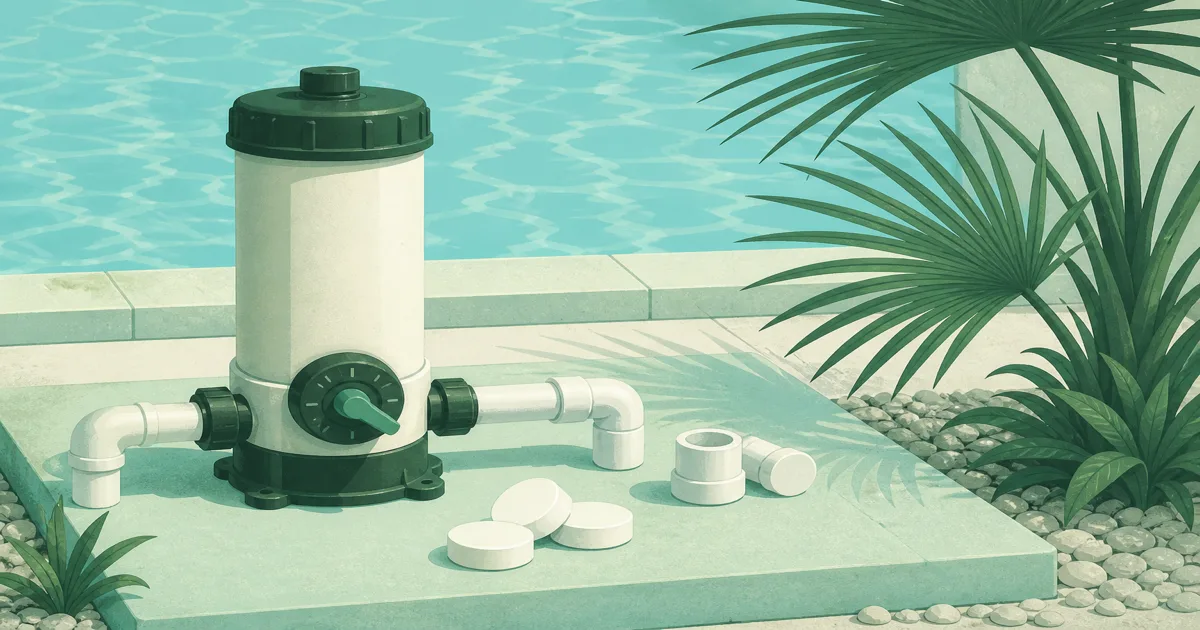
An automatic chlorine feeder is a sealed canister on the equipment pad that dissolves tablets into return water while the pump runs. You set a dial, refill tablets, and stop fishing a floating basket out before every swim.
It is not set-and-forget forever. You still test, and you still shock after parties or storms. Browse water care and keep the best pool test kit pillar next to the pad. More guides live on the blog, and the homepage maps the rest of the site.
Is a feeder better than a floater?
For steady dosing, a feeder does the work for you. It keeps tablets out of the water, doses through the plumbing, and lets you tune the rate with a dial. A floater is cheaper and needs no plumbing, but it drifts and it can park against a wall or get treated like a pool toy. A salt cell is a different project with its own sizing and salt bags.
What does a feeder cost to run?
The feeder body is a one-time buy: $124.99 for the CL200EF, $125.10 for the CL220EF, and $99.99 for the CL100. After that, the running cost is tablets. A 3-inch slow-dissolve tab is roughly 7 to 8 ounces, and a busy in-ground pool can go through several a week in summer, so tablet spend usually passes the hardware cost in the first season.
Budget one accessory the day you install: a lid wrench with spare O-rings, about $8.49, and a union connector pack near $23.45 if you want to service the feeder without re-gluing pipe. Those two small items decide whether opening the canister next spring is a two-minute job or a plumbing project.
What is the difference between in-line and offline?
In-line means the feeder is part of the return pipe, so all the water that goes back to the pool passes through the canister. Offline means the feeder sits beside the pipe and taps the flow with two small tubes, so you never cut the main line. In-line doses with the full return flow; offline doses with whatever the taps pull. Both work, and the choice is about your plumbing, not the chemistry.
Where does the feeder go in the plumbing?
It goes on the return side, after the filter and any heater. The inlet sits between the pump outlet and the filter inlet on an offline setup, and the return port feeds the pool. Tablet water is acidic and harsh, so it must not loop back through the filter or the heater.
Always plumb after filtration. Tablet water is hard on filter media and heater parts, and a wrong routing leads to expensive repairs. If the pad is crowded, that is a reason to choose the offline CL220EF rather than force a tight in-line cut.
Does a feeder raise stabilizer (CYA)?
Yes, and this is the part most feeder guides skip. Trichlor tablets are stabilized, which means they add cyanuric acid as they dissolve. Run tablets all season and CYA climbs, and once it is high, chlorine stops working as well and you need more of it for the same result.
The practical rule is to test CYA every few weeks with a kit from best pool test kit and compare it against the level your pool wants. When CYA drifts high, cut the dial, dose with liquid chlorine, and let the stabilizer come down with dilution. Keeping the dial low in the first place is easier than fixing it later.
How do you choose an automatic chlorine feeder?
Capacity is the second decision after install style. A 9 lb canister is the busy-pool size; a smaller unit is fine for an above-ground shell that uses one or two tablets a week. Match the feeder to pump flow so the dial has room to move residual up and down, and add service unions while the pipe is open.
Top pick: Hayward CL200EF in-line
The Hayward CL200EF is the default automatic chlorine feeder for a typical in-ground PVC pad. You cut into the return after the filter, mount the canister, and dial the feed rate once free chlorine readings settle.
Owners like the roughly 9 lb capacity because summer weeks stop turning into daily tablet chores. Plan the cut carefully, dry-fit first, and consider unions.
Why the CL200EF suits most in-ground pads
It holds the 9 lb class of tablets, it plumbs in-line for steady dosing, and its corrosion-resistant body is built for an outdoor pad. The dial gives you room to tune for pool size and bather load. For a standard in-ground return line, that is the whole job in one box.
Who should skip the CL200EF
Skip it if you cannot cut PVC or you do not want to. The offline CL220EF does the same chemistry with tubing taps. Also skip it if your pool runs low flow and the canister would be oversized, in which case the CL100 is the better fit.
Best offline: Hayward CL220EF
The Hayward CL220EF keeps the same feeder idea without forcing a hard cut on the main return. Inlet and outlet tubing tap the system so the canister can sit where the pad has room. It holds 9 lb of tablets and needs no special venting.
Pick this when the equipment cluster is crowded, the pipe run is awkward, or you want a retrofit that is easier to reverse.
When offline beats in-line
Offline is the better choice on three kinds of pad: crowded equipment clusters, small pipe runs with no room to cut, and rentals or pools where you want to be able to remove the feeder. The tradeoff is more small fittings, so inspect the tubing and clamps at the start of each season.
Best smaller pad: Hayward CL100
The Hayward CL100 fits smaller pools and lower-flow setups that do not need CL200 capacity. It takes 3-inch trichlor tablets, uses the same dial control, and measures about 16 x 8 x 8 inches on the pad.
What the 50 GPM flow rating means
The CL100 lists a maximum flow of 50 GPM. That is a match for many smaller pumps and above-ground systems, and it is the number to check before you buy. If your pump pushes well past that, the canister is the wrong size and you want the CL200 class instead. If your large in-ground pool eats trichlor every few days on a hot week, step up. Undersizing the feeder just means more refill trips and a dial stuck wide open.
How often do you refill tablets?
A 9 lb canister on a busy in-ground pool might need a top-up every week or two in summer, less in a small pool or a cool stretch. The dial setting, water temperature, and bather load all move the number, so check the canister weekly at first, then settle into a rhythm once your readings stabilize.
Do not fill it and forget it. A canister that runs dry for a few hot days is how a pool turns green between swims. If you are going away, lower the demand first by shocking with pool shock and trimming summer debris.
What do you still have to test?
The dial is not a brain. You still test free chlorine, pH, and CYA, and you still shock after storms and heavy bather loads. A feeder holds a residual steady; it does not balance water, and it does not clear algae. That is the same discipline as any tablet setup, so keep a test kit and a shock routine beside the pad.
If you run a salt pool, treat the feeder as a backup for when the salt water chlorinator cell is offline, and keep the dial low so the tablets do not add much CYA. A feeder and a cell can coexist; they just should not both be trying to run full-time sanitation.
Bottom line
Buy the Hayward CL200EF for a clean in-line automatic chlorine feeder install. Buy the CL220EF when offline tubing is smarter. Buy the CL100 for a smaller system. Match tablet size to the canister, plumb after the filter, and test stabilizer so the tablets do not quietly raise your CYA all season.
Frequently Asked Questions
Is an automatic chlorine feeder better than a floater?
A feeder keeps tablets out of the pool and doses through plumbing. A pool chlorine floater is cheaper and needs no PVC work. Pick the feeder when you want pad-side control.
Where does the feeder go in the plumbing?
After the filter and heater on the return side, never before the filter. Tablet water is harsh on filter media and heater guts if it loops the wrong way.
In-line CL200 or offline CL220?
Choose CL200 when you can cut PVC cleanly. Choose CL220 when tubing taps are easier than a hard pipe cut-in.
Can I use bromine tablets in these feeders?
Many Hayward feeders accept slow-dissolving chlorine or bromine tablets when the label allows. Do not mix leftover chemistries in the same canister.
Do I still need to test the water?
Yes. The dial is not a brain. Test free chlorine and adjust the feed rate. Use a kit from best pool test kit.
Will it work with a salt system?
Usually as a backup tablet source when the cell is offline or after a heavy bather week. Keep the dial low so you do not spike CYA from too many trichlor tabs.
How often do I refill tablets?
Depends on pool size, dial setting, and water temp. A 9 lb canister on a busy pool might need a top-up every week or two in summer. Check the canister weekly at first, then settle into a rhythm once readings stabilize.
Does a chlorine feeder raise cyanuric acid?
Yes. Trichlor tablets add stabilizer (CYA) as they dissolve. If you feed tablets all season, CYA creeps up, and high CYA makes chlorine less effective. Test CYA and switch to liquid chlorine or a shock routine when it climbs.