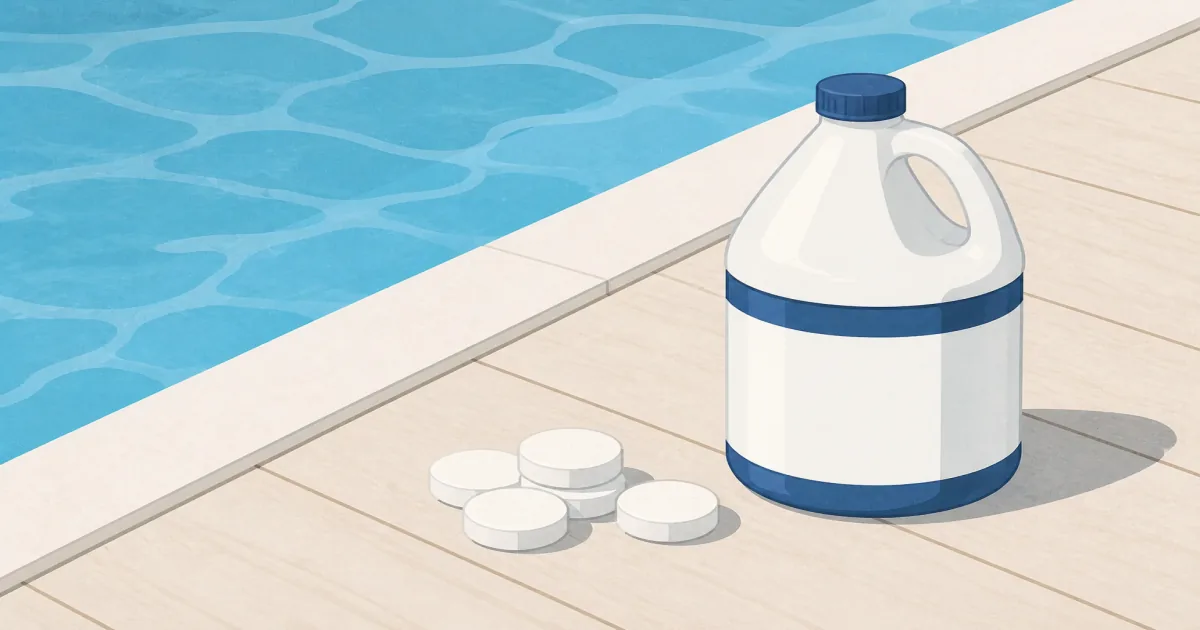
Liquid Chlorine for Pools (2026): Dosing, Strength, and Storage
Water care
Liquid chlorine is the fast, no-stabilizer way to raise free chlorine. Read the date code before you buy and dose for the strength you actually have, not the strength printed on the jug.
Our picks
Liquid chlorine is the plain-language name for sodium hypochlorite sold for swimming pools. You pour it, the pump mixes it, and free chlorine rises. There is no tablet waiting overnight in a floater, and there is no cyanuric acid hitchhiking into the water the way trichlor tabs do.
Liquid sanitizer joins the water care guides on dosing, stabilizer, and shock. That last point is why liquid shows up in so many "my CYA is already high" conversations. If your day-to-day sanitizer has been pool chlorine tablets, stabilizer climbs all season. Liquid lets you keep killing bacteria and algae without stacking more CYA on top.
This guide is for backyard owners choosing a jug, not for commercial drum programs. Cross-check doses with a best pool test kit every time you make a big change, and pair the plan with a pool stabilizer reading if your pool sits in full sun all day.
What is liquid chlorine, and when is it the right buy?
It is sodium hypochlorite, sold at roughly 10% to 12.5% available chlorine, that raises free chlorine within minutes of mixing. Buy it when you need chlorine now and do not want more stabilizer in the water. Buy tablets instead when you want slow residual.
What liquid chlorine does that tablets cannot
Tablets feed a small, steady residual, which is perfect for a pool nobody touches all week. What they cannot do is react. Liquid is the lever you pull on a Saturday morning when the reading is low and guests arrive at noon. It is also the only easy way to keep sanitizing when your stabilizer is already high, because every trichlor tab adds a little more CYA on top of what you already have.
When to skip liquid
Skip liquid as your only plan if you cannot store chemicals safely, or if nobody will test after dosing. A jug without a test kit is guessing with a strong oxidizer. If the pool is fully green, plan a brush-and-shock sequence first, then use liquid to hold the line once the water is clear.
How do I read the date code on a jug?
Most jugs carry a Julian code in YYDDD form, where the first two digits are the year and the next three are the day of the year. A code like 24234 means day 234 of 2024, which lands in late August. Read it before checkout.
That single habit separates a jug that performs from a jug that wastes a trip. Big-box garden centers stack chlorine on outdoor pallets, so the bottom jugs can be a year old before anyone buys them. Local pool stores that turn stock quickly will usually have fresher product, and they will tell you the code if you ask.
How fast does liquid chlorine lose strength?
Faster than the label suggests. Sodium hypochlorite at 12.5% reaches about half strength in 180 days stored at 77°F, and in roughly 48 days at 95°F. In practice, a 12.5% jug can drift toward 10% inside 30 days, and higher concentrations decay faster than lower ones.
The practical translation is simple. Buy what you will use in weeks, not a year. A garage shelf in July can sit above 95°F, which is the fast lane for decay. A cool cabinet in a shaded shed is the slow lane. Same jug, very different September.
What that does to a dose chart
The common "one gallon per 10,000 gallons" rule of thumb assumes fresh 12.5% product. If a jug has half-lived, pouring the same gallon delivers roughly half the free-chlorine lift, and you will blame the pool instead of the bottle. Retest after each dose and let the test drive the second pour. A best pool test kit settles this in a few minutes.
How often should I add liquid chlorine?
There is no single schedule that fits every pool. Start around 3 to 5 ppm of free chlorine daily, test daily for a week or two, and let that pattern set your schedule. Most owners settle at every other day, or twice a week with a cover on.
Dose in the evening. The sun burns off free chlorine during the day, so an evening dose works overnight instead of competing with UV. Keep the pump running, and give the water at least 30 minutes to mix before you retest.
A bigger pool simply means bigger pours. Owners of a 32,000-gallon pool report running about a gallon of 10% chlorine every three to four days. Size your dose to your gallons, not to a fixed jug count.
Should I shock on a calendar?
No. Save the high dose for when combined chlorine climbs or algae shows up. Routine care is a steady residual, not a weekly blast. If the water turns, our pool shock guide covers the knockdown.
How do I dose without drama?
Test first, then dose one product at a time. Brush and circulate so dead organics are not hiding the reading, calculate your gallons, and follow the jug chart. Pour with the pump on, stay out of the water until free chlorine is back in a comfortable swim range, then retest before you add anything else.
- Test free chlorine, pH, and alkalinity first.
- Brush and run the filter so dead organics are not hiding the reading.
- Calculate pool gallons, then follow the jug ounce or gallon chart.
- Pour with the pump on, along the deep end, not into the skimmer.
- Retest. Adjust once. Do not stack mystery products in the same hour.
Which liquid chlorine jug should you buy?
Both are sodium hypochlorite with no added cyanuric acid. Read the date code, buy what you will use in a few months, and keep it cool and shaded. A good target is to finish a jug within about 6 to 9 months of the manufacture date.
Case workhorse: CPDI Champion 4-pack
A four-jug case of CPDI Champion Pool Shock Liquid Chlorine (1 gal each, 12.5%) is the practical buy for owners who dose often. The Champion liquid-chlorine family has a large number of owner reviews, because backyard pools go through this category all summer. The label strength is high enough that a normal dose actually moves the needle on free chlorine.
Use it with the pump running. Walk the pour along the deep end so you do not bleach one vinyl step. Retest after a full circulation cycle. If you still sit below target, add another measured dose instead of emptying the jug "until it smells like a water park."
The tradeoff is freshness. Warm garages age liquid chlorine. Buy a case you will finish this season, not a stack that sits until Labor Day.
Single-gallon pick: CPDI Champion
CPDI Champion Pool Shock Liquid Chlorine (1 gal, 12.5%) is the spare-jug pick. Same job, smaller commitment when you only need one container for a weekend recovery or a midweek top-up.
Keep it upright, capped, and away from acid bottles. Never mix liquid chlorine with acid in the same bucket. If you also lower pH with muriatic or dry acid, dose them separately with plenty of circulation between steps. Our pool pH decreaser guide covers the acid side of that balance.
What should I not mix with liquid chlorine?
Never mix it with acid, ammonia, or household cleaners in one container. Even small amounts of acid and hypochlorite together release chlorine gas. Dose them separately, with the pump running and at least 30 minutes of circulation between them, and store the jugs on separate shelves.
Storage, safety, and strength fade
Keep jugs cool, upright, and out of direct sun. Wear eye protection when pouring. Rinse spills. Keep kids and pets away from the chemical shelf. If a jug bloats, vents, or smells wrong, treat it as a disposal problem, not a bargain. Cloudy water after a big dose usually means the filter is catching debris you just oxidized, so clean or backwash when pressure climbs. Clarifier is a later tool, not a substitute for sanitizer, and our pool clarifier guide covers that step.
When should I choose something else?
Choose tablets if you want set-and-forget residual and your CYA is still low. Choose a full shock-and-brush sequence if the pool is green, then return to liquid for maintenance. If you are converting to salt, liquid becomes the occasional helper rather than the daily jug, so pair that path with pool salt and a salt water chlorinator.
If the water still looks hazy after a successful liquid dose, the issue is probably filter media, not chlorine. A cartridge rinse or a pool filter cleaner soak restores flow without dumping more jugs on top of an already-stressed filter.
Bottom line
Liquid chlorine for pools is the fast sanitizer when you need free chlorine now and you do not want more stabilizer. Start with the CPDI Champion 4-Pack Pool Shock Liquid Chlorine for regular use, keep a CPDI Champion single gallon as a spare, read the date code before you buy, and dose for the strength the jug actually has. Store the jugs cool so the label strength stays honest.
Frequently Asked Questions
What is liquid chlorine for pools?
It is sodium hypochlorite solution, usually around 10% to 12.5%, that raises free chlorine as soon as it mixes. It does not add cyanuric acid the way trichlor tablets do.
Is liquid chlorine the same as pool shock?
It can be used as a shock when you dose high enough, but many shock bags are cal-hypo granules. Liquid is a different form with different storage rules. See pool shock for granular knockdowns.
How do I read the date code on liquid chlorine?
Most jugs use a Julian code in YYDDD form. A code like 24234 means the 234th day of 2024, which is late August. Read it before checkout, because a jug can sit on an outdoor pallet for a year and lose most of its punch.
How much liquid chlorine per 10,000 gallons?
Follow the jug label. A common rule of thumb for fresh 12.5% product is roughly one gallon per 10,000 gallons to raise free chlorine several ppm, then retest. That rule assumes a fresh jug, so scale up once the jug has aged.
Will liquid chlorine raise cyanuric acid?
No. That is why owners with high stabilizer often prefer liquid for day-to-day sanitizer after tabs pushed CYA too far. Stabilizer still matters for sun protection; see pool stabilizer.
Can I pour it in the skimmer?
Prefer the deep end or in front of a return with the pump running, unless the label says otherwise. Dumping strong liquid into a quiet skimmer basket can bleach equipment and create hot spots.
How long does an opened jug last?
Fresher than you think, less than you hope. A 12.5% jug reaches about half strength in 180 days at 77°F, and in roughly 48 days at 95°F. Buy what you will use in weeks and store it cool and shaded.
Tablets or liquid for daily care?
Tablets are the slow feeder in a pool chlorine floater. Liquid is the fast lever when you need chlorine now without more stabilizer.
Is bleach from the grocery store the same?
Household bleach is weaker and sometimes has additives. Pool liquid chlorine is sold for water treatment at higher available chlorine. Stick to pool-labeled jugs for dosing math you can trust.
How often should I put liquid chlorine in my pool?
Start from a target and let the test decide. Trouble Free Pool suggests beginning around 3 to 5 ppm of free chlorine daily, then testing daily and adjusting until you know your pool's daily appetite. A covered 32,000-gallon pool can run on about a gallon of fresh 10% every three to four days. Hot, sunny, and busy weeks burn through it faster.
Which liquid chlorine is best for pools?
Buy the freshest 12.5% jug you can find. CPDI Champion 4-Pack Pool Shock Liquid Chlorine is the case to keep on the shelf because the strength moves the needle on a normal dose. CPDI Champion Pool Shock Liquid Chlorine is the single-gallon spare. Check the date code and buy what you will use in a couple of months.