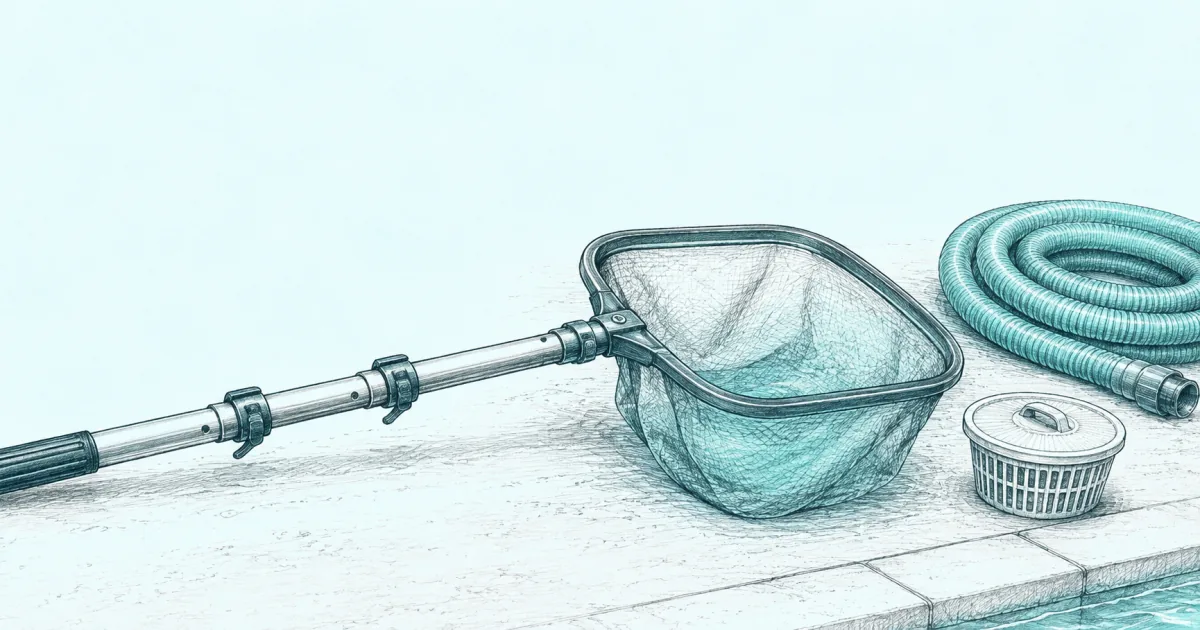
Best Pool Skimmer Pole (2026): Length, Lock Fit, and Net Pairing
Accessories
A pool skimmer pole earns its space when it reaches the center of the pool and locks tight at length. Pair a 12 to 15 ft telescoping aluminum pole with a deep mesh net that clips on with the standard 1-1/4 inch end.
Our picks
A flat skimmer net works fine if the deck sits right next to the leaves. The minute a pile lands two body-lengths from the edge, a short pole starts costing more time than the scoop is worth. A telescoping skimmer pole fixes that by reaching the center of the pool from the deck, with a cam lock that holds length under a normal scoop. Pair the pole with a deep mesh net that clips on the standard 1-1/4 inch end, and one shaft runs skimming, brushing, and vacuuming.
This guide lives under pool accessories next to the broader best pool skimmer pillar. For the wall-and-floor scrubbing side, see best pool brush and pool brush pole. For full-floor cleanup, see best pool vacuum.
Why reach matters more than pole weight
The right length is the distance from the deck edge to the center of the pool plus a foot of slack. Anything shorter leaves the middle out of reach. Anything longer adds flex that wags the net and dumps leaves back into the pool.
For most compact in-ground pools, a 12 ft pole works. For wider pools or decks that sit only on one side, 15 ft is the safer pick. One-piece 16 to 18 ft poles are stiffer at full extension, but they do not fit in a normal deck box.
A second reach test is the body. If you have to lean past the rail to make the center, the pole is too short. If you are reaching at full arm with no slack left in the cam, the pole is right and your stance is wrong.
Match the pole to the head before you buy
The standard home pool tool end is a 1-1/4 inch diameter with an EZ clip. Almost every skimmer net, leaf rake, wall brush, and vacuum head uses the same end. That is why one good telescoping pole replaces three weak ones in the shed. Check the head you already own before ordering a replacement. A loose fit pops off underwater, and a tight fit cracks the plastic collar on the head.
If your existing heads use a slightly different end, a 1-1/4 inch rubber adapter is cheaper than buying a new pole. Adapters also save a pole that has lost its spring-clip after a few seasons of pool water.
Top pick: Poolvio 15 FT Telescopic Pool Pole
The Poolvio 15 FT Telescopic Pool Pole is the safe first buy for most homes. Three pieces of anodized aluminum telescope from a short collapsed length to 15 ft, with a strong-grip cam lock that holds the section under a normal scoop. The 1-1/4 inch end fits the standard residential skimmer net, leaf rake, vacuum head, and wall brush that already live in your shed.
The anodized finish resists corrosion in chlorinated and saltwater pools. Collapsed, the three-piece shaft fits in a standard deck box or hangs on a shed hook. Extended to about 12 ft it covers most compact in-ground pools from one side. Pushed to 15 ft it reaches the center of wider pools when the deck only sits along one edge.
Two tradeoffs to know. At full 15 ft extension, the shaft flexes more than a one-piece pole, so avoid pushing a heavy vacuum head at full reach. And if you skim only at length every day, a stiffer one-piece 16 ft pole is a calmer tool. Most owners skim at half-extension and pull out the long reach only after wind events.
Skimmer head pairing: LIME POOL Heavy Duty Deep Mesh Pool Skimmer Net
The LIME POOL Heavy Duty Deep Mesh Pool Skimmer Net is the net head that earns the rest of the kit. A deep fine-mesh bag holds a real leaf pile between empties, so a single skim pass through a windy corner can lift the day's drop in one go. The reinforced polypropylene frame survives daily scooping without bowing, and the rounded lip is gentle on vinyl liners and plaster.
The net clips onto the standard 1-1/4 inch pole end with no adapter. That is the same end as the wall brush and the vacuum head, which is the whole reason one telescoping pole replaces three weak ones.
Pole and net are sold separately, so the kit costs more than either alone. The tradeoff is flexibility: the same pole runs a flat net on calm days, a deep net on storm days, a wall brush midweek, and a vacuum head when the floor needs help.
Pairing the pole with a leaf rake for sunk debris
A skimmer pole and a flat net cannot lift leaves that already sank after a wind event. That is the pool leaf rake job: a deeper bag that drags the floor and pulls up what the skimmer net missed. The same telescoping pole runs the leaf rake with no adapter, so one shaft covers surface and floor cleanup on different passes.
After a windy day, walk the floor with the leaf rake before you skim the surface. The water will be cloudy with stirred silt, but the bulk of the debris will be in the bag instead of settling back to the deep end. Then switch to the skimmer net and pull the floaters before they sink.
Length and lock habits that keep the pole alive
Rinse the sections after every swim day. Chlorine and saltwater sit on the cams and slowly eat the finish. Dry the cams before collapsing so grit does not pack into the locking teeth. When you extend, give each cam a firm half-turn past the click. A cam that closes with a soft tap will slip the first time you scoop a full bag.
If a cam will not hold, take the pole apart and clean the locking teeth with a small brush. Pack the cams with a thin film of silicone grease once a season if your pool runs hot. Replace a pole that slips under a normal scoop. The cost of a new pole is less than the cost of a liner scratch from a slip mid-stroke.
Avoid using the pole as a lever. It is built to push a brush and steer a net, not to pry a stuck cleaner loose or drag a folded solar cover across the deck. A bent section turns a working pole into a stick that whips every stroke.
Storage that keeps the kit together
Hang the pole, the net, and the wall brush on three hooks by the gate. A tidy station means the next person can find the kit in thirty seconds after dinner. Standing the pole in a corner or leaning it against a hot fence cooks the cams and ages the finish faster than pool water does.
Collapse to the shortest length for storage so the inner sections do not flex under their own weight. A hook in a dry shed keeps the pole out of standing water and off wet grass, both of which shorten the life of the aluminum finish.
When the skimmer pole is the wrong tool
Skip the telescoping skimmer pole if your pool is small enough that a short hand-held net reaches the center. A short pole is faster to grab and store, and a long pole just adds flex you do not need.
Skip the deep mesh net if your pool is mostly pollen dust on calm days. A flat fine-mesh net is faster for thin debris and easier to rinse. Save the deep bag for wind events and after yard work that drops branches into the water.
Skip a one-piece long pole if you do not have somewhere to store it. A 16 ft pole that leans in the corner will warp in the first summer. A telescoping pole that collapses to under 5 ft lives on a hook with the rest of the deck kit.
Bottom line
Buy a telescoping skimmer pole that reaches the center of the pool from the deck and locks tight at length. The Poolvio 15 FT Telescopic Pool Pole is the safe first buy for most homes, with the standard 1-1/4 inch end that fits the rest of your deck kit.
Pair it with the LIME POOL Heavy Duty Deep Mesh Pool Skimmer Net for the leaf and pollen job, and keep the same pole running the wall brush and vacuum head on different days. The kit earns its hooks by the gate when one shaft replaces three weak ones and the net actually fits it.
Frequently Asked Questions
What length pool skimmer pole do I need?
Pick the shortest pole that reaches the center of the pool from the deck with a little to spare. A 12 ft pole works for many above-ground and compact in-ground pools. A 15 ft pole is the safer pick for most residential in-ground pools. Go to 16 to 18 ft only if you have a wide pool or no deck on one side.
Are all pool skimmer poles the same diameter?
Most home pool skimmer poles use a standard 1-1/4 inch connection on the head end. That covers the majority of skimmer nets, leaf rakes, vacuum heads, and wall brushes. A few pro-grade or telescoping two-piece models use a slightly different end, so check the listing before pairing.
Why does my telescoping pole keep sliding shorter?
The cam locks are usually loose, worn, or packed with grit. Rinse the sections after every swim day, dry the cams before collapsing, and replace the pole if a lock will not hold under a normal scoop. A pole that slips mid-stroke scrapes liners and dumps leaves back in.
Can I use the same pole for skimming and brushing?
Yes, if both heads share the same 1-1/4 inch end. A telescoping pole earns its space by running a skimmer net on Monday, a wall brush on Wednesday, and a vacuum head on Friday. The same pole also works for the pool brush pole job; see that guide for length and lock tips.
What is the best skimmer net to attach?
A deep fine-mesh net is the right first buy for surface leaves and pollen. A flat fine-mesh net is faster for thin debris on calm days. Pair the net with a pool leaf rake for sunk debris after wind events. The broader kit lives in best pool skimmer.
Will a skimmer pole scratch a vinyl liner?
Not the pole itself, but a hard plastic rim on the net can scrape a liner if you scoop along the wall. Round the lip, keep the net at a slight angle to the wall, and avoid driving the pole tip against the floor when you are mid-stroke. The same rules apply to the best pool brush head on vinyl.
How do I store a telescoping skimmer pole?
Rinse the sections, drain the cams, collapse to the shortest length, and hang it off the ground in a dry spot. Wet grass at the base of a leaning pole is how aluminum cooks and cams corrode. A shed hook by the gate keeps the kit together with the net and brush.
What is the difference between a skimmer pole and a brush pole?
Nothing mechanical. Both are telescoping aluminum shafts with a 1-1/4 inch end. The difference is the head on the end and the cleaning job. Skimmer nets ride low and lift; wall brushes ride flat and scrub. Many owners buy one good pole and swap heads.