Best Suction Pool Cleaner for Inground (2026): Suction Side vs Robot
Vacuums
The best suction pool cleaner for an inground pool is the Hayward Poolvergnuegen 4-Wheel for a large in-ground. Choose the PoolVac XL for concrete fine dirt, or the VINGLI for a simple above-ground floor. Reach for a robotic cleaner when you want independent filtration.
Our picks
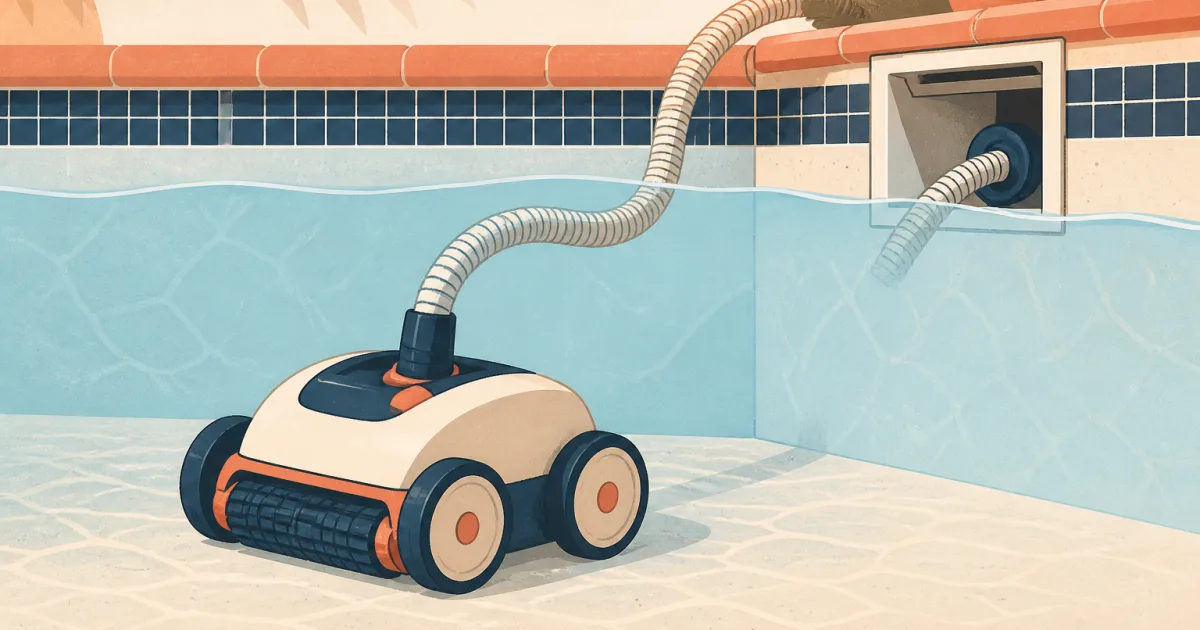
A suction-side cleaner is a sensible middle ground between pushing a manual vacuum and paying for a robotic cleaner. It connects to the skimmer or a dedicated suction port. Your pool pump pulls debris through the hose and into the existing filtration system.
Browse more options in the vacuums section. For pressure-side Polaris-style cleaning instead, see best pool vacuum. For independent filtration and scheduling, see best robotic pool cleaner.
That simple setup also creates the main buying risk. A cleaner can be excellent and still disappoint if the hose is too short, the pump flow is wrong, or the cleaner is made for a different pool surface. Start with your pool, not the product photo.
A large in-ground pool with a deep end wants traction and hose length. Concrete that holds fine dirt wants a wide, quiet inlet. An above-ground vinyl floor wants a simpler skimmer-hooked unit. Get those three matches right and the cleaner spends the afternoon covering ground instead of sitting in a corner.
Which suction pool cleaner fits your pool?
Specs that decide the fit
A few numbers do most of the deciding. The four-wheel Poolvergnuegen travels 11 to 14 feet between turns and swings its steering from 90 to 540 degrees. The VINGLI diaphragm is rated about 200 hours and works to a maximum depth of 9.8 feet. The PoolVac XL climbs concrete only where the wall meets the floor with a 7-inch radius or better, and its rear flap has set adjuster positions from I to III.
What the three cleaners have in common
All three connect to the skimmer or a dedicated suction port and use your existing pump, with no booster pump and no onboard filter basket. You choose between them by pool size, pool surface, and the kind of debris you fight.
The first two picks both use the pool's existing suction, but they move differently. The Poolvergnuegen rides on four wheels and uses programmed steering. The PoolVac XL uses a turbine, wings, and a skirt to move quietly across the pool. The VINGLI uses a diaphragm-driven above-ground design for a smaller, flatter job.
Suction side vs pressure side: which do you have?
A suction side cleaner connects to the skimmer or a dedicated suction port and pulls water toward the pump. Debris travels through the cleaner, the hose, and the baskets before it reaches the filter. That is the setup on all three picks here, and it is the one that uses the pump and plumbing you already own.
A pressure side cleaner is the opposite. It runs on return-side water and usually carries its own debris bag, and some models need a booster pump to drive them. Pressure cleaners handle large debris well, but they add a pump and a bag to your routine.
The names trip people up because a "suction side pool cleaner" and a "suction pool cleaner" are the same category. If you have read that a cleaner needs a booster pump, that is the pressure side, not this one. Our best pool vacuum guide covers the pressure side and cordless handheld options.
Suction pool cleaner vs robotic: which is better?
A suction cleaner costs less up front and uses plumbing you already own. A robotic cleaner costs more but cleans independently. On a 20 by 40 pool, the right choice comes down to your pump and how much you value not thinking about flow.
Why a suction cleaner costs less to run
A suction cleaner borrows flow from the main circulation pump and sends debris into the pool filter. It has no onboard electronics to charge or store. The tradeoff is that performance depends on the pool's plumbing and clean filter flow.
Why a robotic cleaner costs more but does more
A robotic cleaner has its own motor and onboard filter basket. It leaves the main circulation system alone, can offer scheduled cleaning, and traps fine silt that the pool filter might miss. The tradeoff is a higher purchase price and another filter basket to rinse after each cycle.
Which one wins on a variable-speed pump?
The honest answer for a 20 by 40 in-ground pool on a working single-speed or two-speed pump is that the Poolvergnuegen covers ground all afternoon on a budget the robot cannot match. On a variable-speed pump that cannot spare the flow, or for a pool owner who wants scheduled cleaning without thinking about pump speed, the robotic cleaner is the right call. See best robotic pool cleaner for robotic cleaners.
Best for large in-ground pools: Hayward Poolvergnuegen 4-Wheel
Why the Poolvergnuegen suits large, deep pools
The Hayward W3PVS40JST Poolvergnuegen 4-Wheel Suction Pool Cleaner is the best fit when an in-ground pool is large, has a deep end, or needs more traction than a basic suction cleaner can provide. Hayward lists it for pools up to 20 by 40 feet. The included hose reaches 40 feet, which matters just as much as the cleaner's drive system.
Four-wheel drive helps the cleaner maintain contact as it changes depth. Programmed steering periodically reverses a wheel so the cleaner can turn and cover another part of the pool. It is not mapping the pool like a modern robot. It follows a repeatable mechanical sequence, so the hose setup and return-jet direction still affect where it goes.
Flow settings that keep it moving
The interchangeable suction throats are useful with a variable-speed pump. A smaller throat can help at lower flow, while a larger opening gives bigger debris more room to pass. You still need to calibrate flow according to the manual. Turning the pump up until the cleaner races around can reduce skimming and increase hose tangles.
This is also the most surface-flexible pick. The listing covers gunite, vinyl, fiberglass, pebble, and tile. Owners report good floor and wall coverage when the cleaner is balanced correctly. The repeated complaints are also practical: it may struggle around some main drains, and the four-wheel model costs more than a simple flapper cleaner.
Who should skip the Poolvergnuegen
Choose it when pool size, a deep end, and mixed surfaces justify the price. Skip it for a small above-ground pool or a yard where giant leaves are the daily problem.
Best for concrete pools: Hayward PoolVac XL
Why the PoolVac XL suits concrete and fine dirt
The Hayward 2025ADC PoolVac XL is a quieter choice for concrete and gunite pools. It connects to the skimmer or a dedicated suction line, then sends debris to the pool's filtration system. There is no debris bag to empty and no booster pump to install.
Its wing and skirt design maintains suction while the turbine drive follows a programmed path. Owners often mention that it is quiet compared with clicking or pulsing suction cleaners. They also describe it working at practical variable-pump speeds once the flow and hose are adjusted.
Fine dirt is the better match for this model. It can collect normal pool debris, but large leaves are a known weak point. A stiff leaf can block the inlet, and a pile of leaves can fill the skimmer or pump basket quickly. If the pool sits under deciduous trees, add an inline canister or choose a cleaner with a wider debris path.
What limits its wall climbing
Wall climbing depends on the pool shape, flow, hose balance, and condition of the cleaner's wear parts. Some owners report good wall coverage. Others say it climbs partway and drops. Buy it primarily for quiet floor cleaning in a compatible concrete pool, not because you expect it to scrub every step and waterline.
Best for above-ground pools: VINGLI Suction Pool Cleaner
Why the VINGLI suits above-ground pools
The VINGLI Suction Pool Cleaner is the above-ground pick. It runs on your pool pump rather than electricity, ships with 33 feet of hose, a regulator valve, hose weights, a wheel deflector, and a spare diaphragm. For a round or oval above-ground pool with a flat floor, it delivers a lot of cleaning for the price.
Setup that stops the pump losing prime
Setup is the make-or-break step. You need a pump of at least 3/4 hp, or roughly 1,700 gallons per hour, or the cleaner will sit still. Fill the hose with water and bleed the air before connecting it, then set the weights so the cleaner stays flat instead of drifting to the deep end. The regulator valve fine-tunes how much suction goes to the cleaner versus the skimmer.
This is a fine-debris machine. It handles sand, silt, and dirt well, and the wheel deflector keeps it from wedging in corners. Large leaves and sticks are a different story, and a ladder left in the pool will trap it. Expect to check the diaphragm now and then, since it is the only moving part and the usual wear point.
Who should skip the VINGLI
Buy it if you have an above-ground pool, a 3/4 hp pump, and mostly fine debris. Skip it if your pump is small, your pool is full of big leaves, or you want a cleaner you never touch.
What plumbing do you need before you buy?
Skimmer or dedicated suction port?
A suction pool cleaner needs one of two connections: a skimmer with the correct adapter or a dedicated suction port. Do not connect it to a return jet. The return side pushes filtered water back into the pool; the suction side pulls water toward the pump.
Hose length and air leaks
Check the hose diameter and included adapters. Then measure from the connection point to the farthest corner of the pool. Most manufacturers tell you how much extra hose to add. More is not always better. A hose that is much too long can knot, drag, and keep the cleaner in one area.
Inspect the pool vacuum hose if you already own one. Cracked cuffs and pinholes pull air into the system. That can make a cleaner slow down, cause bubbles at the return jets, and make the pump lose prime.
Does your pump have the flow?
Finally, confirm that your pump can provide the required flow. Follow the cleaner's regulator, flow gauge, or wheel-speed instructions. The goal is steady movement with good skimming, not maximum speed.
Which debris and surfaces suit a suction cleaner?
Fine sand, silt, and pollen move through a suction cleaner more easily than large leaves. The debris then reaches the skimmer basket, an inline canister, the pump basket, or the pool filter. Check those places during the first few cycles. A cleaner that starts strong and slows after 20 minutes may simply be filling a basket.
For heavy leaves, use a compatible inline canister between the cleaner and the suction connection. It keeps bulky debris out of harder-to-reach plumbing and lets you see when the basket is full. The canister will not fix weak flow or an air leak.
Pool surface matters too. The Poolvergnuegen covers a broad list of surfaces. The concrete PoolVac XL is specifically shaped for gunite and concrete. The VINGLI is meant for simpler above-ground floors. Buying the wrong skirt, tire, or shoe setup can cause poor traction or premature wear.
A pressure-side cleaner runs on return-side water and often carries its own debris bag, and some models need a booster pump. Our best pool vacuum guide covers the Polaris pressure-side cleaners and a cordless handheld option.
What setup mistakes make a good cleaner look bad?
Fill every hose section with water before connecting the cleaner. Trapped air can send bubbles through the pump and reduce suction. Keep hose sections straight during storage so they do not develop curves that steer the cleaner into the same corner.
Use the exact number of hose sections recommended for the pool. Place weights and floats where the manual shows. Point return jets so they do not push the hose into a knot. If the cleaner sticks on a main drain, use the manufacturer's recommended drain cover or adjustment rather than improvised weights.
Clean the skimmer basket, pump basket, and filter before judging performance. A dirty filter raises system resistance. A full basket cuts flow. Check for leaks around the pump lid and hose cuffs if the cleaner pulses, slows, or causes bubbles at the returns.
Make one adjustment at a time. Changing pump speed, hose length, weights, and return direction together makes it hard to tell what fixed the problem.
Bottom line
Buy the Hayward Poolvergnuegen 4-Wheel for a large in-ground pool where traction, a deep end, and surface flexibility matter. Choose the Hayward PoolVac XL for quieter fine-dirt cleaning in a concrete or gunite pool. Pick the VINGLI Suction Pool Cleaner for an above-ground pool with a 3/4 hp pump and a simple floor.
Whichever cleaner you choose, measure the hose path, confirm the suction connection, and check available pump flow before ordering. A correctly matched suction cleaner can handle routine floor debris for years. The wrong cleaner will spend most of its time parked by the steps.
Frequently Asked Questions
What is the best suction pool cleaner for a large in-ground pool?
The Hayward Poolvergnuegen 4-Wheel is the strongest fit here for a large in-ground pool up to 20 by 40 feet. Its four-wheel drive, 40-foot hose, and interchangeable throats give it more range and flow flexibility than the smaller picks.
Which is better, a robotic or suction pool cleaner?
A suction cleaner borrows flow from your main pump and sends debris into the existing filter, so it costs less upfront and uses plumbing you already own. A robotic cleaner has its own motor and onboard filter, so it leaves your pump and filter alone but costs more upfront. Pick suction when your pump can spare the flow and you want a lower purchase price. Pick a robot when you want independent filtration and easier scheduling, especially on a variable-speed pump.
Are suction-side pool cleaners good?
Yes, when matched to the pool. A suction-side cleaner on a 20 by 40 in-ground pool with a strong pump and clean filter is going to cover real ground and pull debris all afternoon. The same cleaner on a small above-ground pool with a weak pump will starve and sit in a corner. The cleaner is only as good as the pump flow behind it.
What vacuum do professional pool cleaners use?
Pros use a mix depending on the job. Many route a manual vacuum head through a dedicated suction port with a long hose for fine dirt and spot work. For full-pool automatic cleaning, pros use either a suction-side cleaner like the Poolvergnuegen on a working pump, or a robotic cleaner with onboard filtration when the job calls for independent scheduling.
Is there a pool vacuum that actually works?
Yes, but the vacuum is only the head. The full system is a vacuum head, a hose sized to your skimmer and head, a pump that can spare the flow, and a clean filter. If any one of those is wrong, the same vacuum that worked yesterday will sit on the bottom today. Start with the hose and pump, then pick the head.
Will a suction pool cleaner work with a variable-speed pump?
It can, but you must give the cleaner enough flow to move without starving the skimmer or pump. The Poolvergnuegen includes interchangeable throats for different flow conditions. Follow the cleaner's wheel-speed or flow-gauge instructions, then note the working pump speed.
Do suction pool cleaners pick up leaves?
They can pick up small leaves, but large or rigid leaves may clog the cleaner, hose, skimmer basket, or pump basket. Use an inline pool leaf canister when leaf load is heavy, and empty it before flow drops.
Can I leave a suction pool cleaner in the pool all the time?
Remove it before swimming and when adding concentrated chemicals. Storing hoses straight and out of direct sun can reduce hose memory and UV wear. Check the manufacturer's care instructions for your exact model.
Why does my suction cleaner stay in the deep end?
Common causes include the wrong hose length, hose memory, poor return-jet direction, incorrect weights or floats, and flow that is too high or low. Start with the manual's hose and flow setup before buying parts.
Is a suction cleaner better than a robotic cleaner for fine dirt?
Suction-side cleaners move fine dirt and silt through the pool's filter, which is the right system for catching it. A robotic cleaner has a finer onboard filter that traps particles the pool filter might miss. For concrete or gunite pools with fine dirt, both work; a robotic cleaner with a fine-mesh filter catches more silt per cycle, while a suction cleaner like the PoolVac XL is the cheaper setup with a wider inlet.
Does a suction pool cleaner need a booster pump?
No. Suction-side cleaners connect to a skimmer or dedicated suction port and use the pool's main circulation pump. Pressure-side cleaners are the category that may need a booster pump.