Mesh Pool Fence (2026): Removable Safety Fence + DIY Picks
Accessories
A mesh pool fence is a removable, climb-resistant barrier around an in-ground pool. Life Saver and WaterWarden are the strongest DIY picks, both UL certified to ASTM standards for child and pet safety.
Our picks
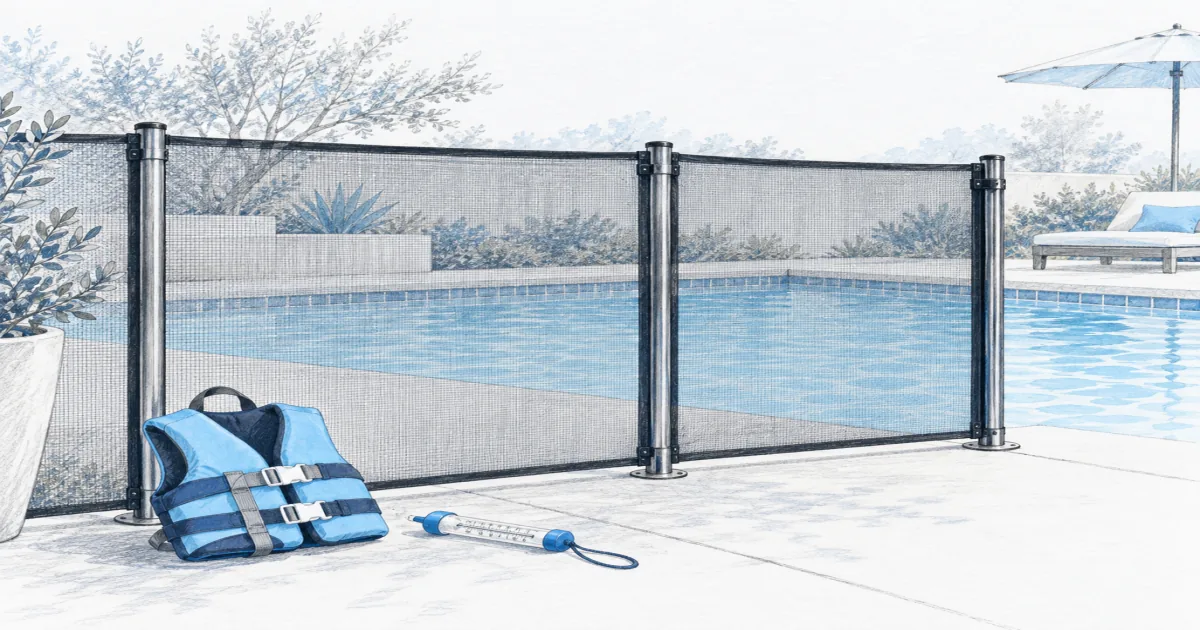
A mesh pool fence is not a winter cover or a heat blanket. It is a removable barrier made of UV-protected mesh stretched between aluminum poles that sit in deck sleeves. When installed, the fence makes a climb-resistant wall around the pool so a toddler or pet cannot wander straight to the water. When you want the pool open for entertaining, you unclip the poles, roll the mesh, and store it.
This guide sits under accessories next to the safety pool cover pillar, which is the deck-anchor cover that supports weight when the pool is closed. The fence is the open-season answer. The cover is the closed-season answer. Most safety-minded pool owners end up with both.
What a mesh pool fence actually does
A good mesh pool fence gives a child-resistant barrier that adults can remove in minutes. The poles anchor into the deck so the fence does not move when pushed. The mesh weave is climb-resistant for small hands and feet, but the panels lift off and roll up for off-season storage.
The fence does not replace adult supervision. It adds a layer of protection for the minutes between "where is the kid" and "where did the kid go." That gap is what most pool accidents happen in, and a fence closes it.
It also does not support weight. A child or pet leaning against the mesh is contained, but the fence is not a deck or a floor. For weight support across the water, you want a separate deck-anchor safety pool cover. The two products do different jobs.
Mesh fence versus chain link versus safety cover
The three common pool-safety products get confused because they all "fence" or "cover" the pool.
A mesh pool fence is a removable perimeter barrier with aluminum poles and mesh panels. It is for the swim season when the pool is open. It rolls up for storage.
A chain link or aluminum fence is a permanent structure with footers and hardware that stays in place year round. It costs more and adds real estate value, but it does not roll up.
A safety pool cover is a deck-anchor sheet that covers the water surface and supports weight when the pool is closed. It is for the off-season.
A mesh fence plus a safety cover is the most complete system for in-ground pools with small children or pets. The fence is up during swim season. The cover goes on when the pool is closed. Both products stay out of the way when you do not need them.
Hero pick: Pool Fence DIY by Life Saver Section Kit
The Pool Fence DIY by Life Saver Fencing Section Kit, 4 x 12-Feet, Black is the strongest DIY pick for most in-ground pools. Each section arrives pre-assembled at 4 ft tall and 12 ft long with five integrated one-inch poles at 36-inch spacing, so the whole run drops onto the deck rather than getting bolted together on site.
Life Saver sections use half-inch stainless pins that set into deck sleeves in concrete or pavers, plus a brass safety latch. The mesh is Textilene PVC-coated nylon with UV inhibitors and a tight basket weave, so it holds color and tension through several seasons of full sun.
The honest limit is the deck surface. Life Saver ships with sleeves sized for concrete or paver decks, and the install needs a rotary hammer with a 5/8-inch masonry bit to drill them. Grass and dirt installs need longer sleeves set in concrete footings, which is a different project. Most DIY owners skip the grass install and put the fence on the existing deck that wraps the pool.
Alternatives in the same lane
If you want a different brand's gate hardware or a section that joins without drilling every panel, a second option earns the spot:
WaterWarden ships 12-ft panels with a spring-loaded latch that joins sections without extra drilling. WaterWarden is UL certified to ASTM F2286 and its coordinated gate mates with the panels.
If your pool sits under a local code that requires a 5-ft fence, look for a 5-ft-rated panel from the same maker as your 4-ft system. The install story is the same, just taller. For most US in-ground pools without a code requirement, the 4-ft panel is enough.
Self-closing gate is mandatory
A mesh pool fence without a self-closing, self-latching gate is not a complete safety system. The gate is the only legal way through the fence, and it is the most common failure point on cheap installs.
Buy the gate from the same maker as the fence. Pool Fence DIY sells a self-closing gate that pairs with their sections. WaterWarden sells a coordinated gate for their system. Both gates are pre-assembled with hinges and a lockable latch that latches at the top, away from small hands.
The gate should swing outward, away from the pool. The latch should be at the top of the gate so a toddler cannot reach it. The self-closing hinge should shut the gate from any open angle, not just from fully open.
If your gate fails the push-test (open it partway and let go; it should close and latch on its own), the hinge spring is too weak or the latch is misaligned. Fix that before you trust the system.
How tall and how long
The standard residential mesh pool fence is 4 ft tall and comes in 12-ft panels or longer sections. A 4-ft fence is climb-resistant for most toddlers and meets ASTM F2286 for residential pools.
A 5-ft fence is the right answer when local codes ask for it, when you have an older toddler who can already climb a 4-ft fence, or when the pool is in a yard that gets daily supervision lapses. The 5-ft panel uses the same poles and sleeves as the 4-ft panel, so the only difference is panel height.
Perimeter length depends on pool size and the deck you want to fence. Measure the deck edge you want to enclose, then add about 10% for trim cuts and a gate opening. A 16-ft by 32-ft in-ground pool usually wants about 100 to 120 ft of perimeter including the deck margin.
Where the mesh fence will and will not work
Mesh pool fences are for in-ground pools with a concrete, paver, or wood deck around them. The deck sleeves need a solid surface to anchor into. The fence does not work on grass or dirt without extra footing work, and it does not work on above ground pools because the deck edge sits above grade.
For above ground pools, the safety story is different. A winter cover with cable-and-winch is not a safety cover. A mesh fence around an above ground pool works if the deck is wide and flat, but most above ground pools do not have the deck space for a fence. The realistic above ground safety layer is a removable pool alarm and adult supervision, plus a solid winter cover that keeps leaves and light off the water.
If you have an above ground pool with toddlers around the deck, the right answer is a removable pool alarm plus a solid cover when the pool is not in use, plus a fence around the deck (not around the pool) to keep the child away from the water's edge. That is a different guide; this one is for in-ground pool owners.
Where the fence meets the rest of the pool kit
A mesh pool fence is one piece of a working pool-safety system. Pair it with the rest of the kit.
When the pool is open: the mesh fence is up, the pool is filtered, the water is balanced, and a pool test kit sits on the deck. A pool skimmer is in the water for leaves. An adult is watching any child in or near the pool.
When the pool is closed: a safety pool cover goes on the water, the mesh fence rolls up and stores in the garage, and a pool cover pump is on standby for rain that lands on the cover. The cover pump is for solid covers; mesh pool fences do not pond.
When the pool is between seasons: the cover is on, the fence is stored, the filter is drained or winterized, and a pool closing kit sits on the deck for next spring's open.
How long a mesh fence lasts
A UV-protected mesh with aluminum poles typically lasts 8 to 12 years with reasonable care. The mesh is the part that ages first, and full sun during storage is what fades it. Roll the fence up and store it out of direct sun during the off-season and the mesh will hold its color and weave for many seasons.
The poles age slower. Stainless steel pegs and aluminum poles do not rust in normal pool-deck conditions. The plastic deck sleeves can crack if you over-tension the mesh or hammer them in too hard. Replace cracked sleeves before they fail and let a fence pole slip out of position.
If the fence has been up year round for 10+ years, it is time to think about a replacement rather than a repair. The mesh weave loses strength as it ages, and a fence that survives a toddler push at year 2 may not survive the same push at year 12.
Common mistakes that waste the fence
Installing on the wrong surface. Grass and dirt need a different sleeve system. Most DIY homeowners skip the grass install and fence the deck that already wraps the pool.
Using the wrong gate. A non-self-closing gate defeats the safety system. Buy the matching gate from the fence maker.
Skipping the trim. Pre-assembled panels are easy to cut, but a straight cut with the included trim strip keeps the mesh from unraveling. Pull-cut mesh looks fine on day one and unravels by spring.
Forgetting the removal plan. A mesh fence that nobody rolls up stays up year round. That ages the mesh faster than anything else. Roll it up in October, store it in a garage or shed, and reinstall in May.
Over-tensioning the mesh. Tight mesh looks neat but it stresses the poles and the deck sleeves. Leave a small bow in each panel so wind has somewhere to flex.
Who should skip a mesh pool fence
If your in-ground pool already sits inside a permanent aluminum or chain link fence that meets local code, the mesh fence is redundant. Skip it. The pool is already protected by a permanent barrier.
If the pool is in a yard where toddlers are never present, the mesh fence is not necessary. Adult supervision and a basic alarm system cover the open-season risk.
If the deck around the pool is not solid concrete or paver, the mesh fence is not a simple DIY project. Talk to a professional installer or pick a different safety layer.
If you want a single product that covers both the open-season barrier and the closed-season weight support, you do not get there with one product. The mesh fence plus a safety cover is the realistic two-product answer.
Bottom line
The Pool Fence DIY by Life Saver Fencing Section Kit, 4 x 12-Feet, Black is the strongest DIY mesh pool fence for most in-ground pools because the pre-assembled 4 x 12-ft sections drop into deck sleeves fast and the tight Textilene weave holds tension for years. Pair it with a self-closing gate for the entry.
Choose WaterWarden when you want UL certification and a spring-loaded latch system that joins 12-ft panels without extra drilling. Step to a 5-ft-rated panel when local codes ask for extra height or when an active toddler is the reason for the fence in the first place.
A mesh pool fence is for the swim season. Add a safety pool cover for the closed season and the system is complete. Both products stay out of the way when you do not need them.
Frequently Asked Questions
How much does a mesh pool fence cost?
A DIY mesh pool fence usually costs about $10 to $15 per linear foot for the sections, plus a self-closing gate kit that runs a few hundred dollars. A 60-ft pool perimeter with one gate lands near $1,000 to $1,400 in materials for a quality DIY install. Professional installation runs higher because the crew drills sleeves and tensions the mesh for you.
Are mesh pool fences safe?
Yes, when they are UL certified to ASTM F2286. The mesh weave is climb-resistant for toddlers, and the poles anchor into the deck so the fence stays in place. The fence is a barrier, not a substitute for adult supervision, but it adds real protection compared with an open pool deck.
Which mesh pool fence is considered the best?
For DIY in-ground installs, Pool Fence DIY by Life Saver and WaterWarden are the strongest picks. Life Saver ships pre-assembled 12-ft sections with five integrated poles, half-inch stainless pins, and a brass safety latch. WaterWarden ships 12-ft panels with a spring-loaded latch system that joins sections without drilling extra holes. Both meet ASTM F2286.
What is the cheapest way to fence a pool?
A removable mesh pool fence is the cheapest way to add a real safety barrier without pouring concrete or building a permanent structure. A basic steel or aluminum fence with footers costs more and stays in place year round. For owners who only need safety during swim season, the mesh fence rolls up and stores in a garage.
How tall should a mesh pool fence be?
Four feet is the standard for residential pools and matches ASTM F2286. Five-foot panels are common for homeowners with active toddlers or local codes that ask for the extra height. Either height works for child safety as long as the fence is UL certified and the self-closing gate latches at the top.
Do I need a gate on a mesh pool fence?
Yes. A self-closing, self-latching gate is the only legal way through the fence, and it is the most common failure point on cheap installs. Buy the matching gate kit from the same maker as the fence. Pool Fence DIY sells a self-closing gate that pairs with their sections. WaterWarden sells a coordinated gate for theirs.
Can a mesh pool fence go on grass or dirt?
The included sleeves are designed for concrete or paver decks. For grass or dirt installs, you need longer PVC sleeves set in concrete footings. Most DIY homeowners skip the grass install and put the fence on the deck or walkway that already surrounds the pool.
How long does a mesh pool fence last?
A UV-protected mesh with aluminum poles typically lasts 8 to 12 years with reasonable care. Fading and brittleness come from full-sun storage, not from the fence being up. Roll the fence up and store it out of direct sun during the off-season and the mesh will hold its color and weave for years.
Is a mesh pool fence the same as a safety pool cover?
No. A mesh pool fence is a perimeter barrier that keeps kids and pets from reaching the water. A safety pool cover is a deck-anchor sheet that sits on top of the water and supports weight. They do different jobs. For full protection, many owners add both: a fence when the pool is open and a safety cover when the pool is closed.