Pool Tile for Above Ground Pools (2026): Waterline Picks
Accessories
Pool tile for an above ground pool is a waterline band that only a rigid wall can hold. This guide names the pools that can take tile, prices a porcelain, a glass mosaic, and a grout repair by the square foot, and gives the set and grout rules that keep the band sharp.
Our picks
An above ground pool can hold a tile band only when its wall is rigid. A steel or resin wall with a top rail gives tile a flat, stable surface to bond to. A soft-sided pool flexes as the water moves, and that movement cracks a rigid tile bed, so those pools keep the printed tile border that comes on the liner.
This guide is for the rigid-wall case. It prices three live picks by the square foot, explains the porcelain-versus-glass trade, and gives the set and grout rules that decide whether the band still looks sharp after a few summers.
Porcelain is the workhorse: dense, budget-friendly, and happy to be scrubbed. Glass is the showpiece: non-porous, colorfast, and quick to show you when the water chemistry drifts. Most waterlines use one or the other, and most repairs are about grout, not tile.
This guide sits with the other pool accessories gear, next to the pool tile brush and pool tile cleaner guides. For the above ground setup picture, start with the above ground pool liner guide and the pool skimmer pillar.
Can you put tile on an above ground pool?
Yes, if the pool has a rigid wall. A steel or resin above ground pool with a flat wall and a top rail can take a waterline tile band. A soft-sided pool flexes with the water and will crack a rigid tile bed, so it is not a tile job.
The dividing line is the wall, not the brand. A rigid-wall pool holds its shape when the water level drops and when swimmers push off the wall. That stability is what lets a thinset and grout bed cure without cracking. A soft-sided pool bows with every wave, and a hard tile edge cannot move with it.
If your pool is soft-sided, skip the tile and protect the liner instead. A liner patch kit handles a pinhole, and a pool pad blunts the rocks and roots that wear a vinyl floor. Tile is a job for a pool that stands on its own.
Which above ground pools can hold tile?
A rigid-wall pool is the right candidate. These pools use flat steel or resin panels, a top rail, and a vinyl liner, and the wall surface is firm enough to bond tile to. The best setup also has a flat, straight wall with no deep ribs in the tile zone.
A soft-sided pool is the wrong candidate. Inflatable and frame pools have a flexible wall that moves with the water, and tile set on a moving wall cracks at the grout lines. Keep the printed border that came on the liner and clean it with the pool tile cleaner instead.
Above ground walls come in a few common heights, including 48, 52, and 54 inches, which the liner guide covers. Height does not change the tile choice. It changes how much band you are covering and how low you can drop the water before you start.
What type of tile belongs on an above ground waterline?
Pool-rated porcelain and glass lead the list, and ceramic is a close third. The dividing line is water absorption: a tile rated for pools should absorb 0.5 percent or less, which keeps freeze-thaw cycles from cracking it.
Above ground pools lean on that spec more than most. The wall sits exposed on all sides, so the tile sees wider temperature swings than a sheltered in-ground band. A dense, low-absorption tile survives that cycle, and a porous one spalls. Porcelain and glass both clear the bar. A decorative wall tile from a home store usually does not.
Where the tile goes matters too. The waterline band takes the worst of the oil and scale, so a smooth, non-porous face pays off. Blues and greens are the classic waterline colors because they flatter the water. A white or charcoal tile reads calm and modern, and it is easier to spot scale on so you catch it early.
What is the tile on the edge of the pool called?
The band at the waterline is waterline tile. On an in-ground pool, the piece on the top edge, where the pool meets the deck, is coping, and it is thicker and slip-resistant because people stand on it. On an above ground pool, the top rail plays that coping role, and the rail is not tiled. The tile sits below the rail, at the water line.
Porcelain or glass for an above ground waterline?
Porcelain is the easier pick for most owners, and glass is the pick for the look. Porcelain takes scrubbing, hides scale better on a textured face, and costs less installed. Glass has no pores to stain, holds its color for decades, and makes the water look deeper, but its smooth face makes calcium more visible when chemistry drifts.
The honest trade is maintenance versus looks. If you test and balance the water every week, glass stays sharp. If your chemistry wanders, porcelain will look better between cleanings, because it does not reflect every mineral streak the way glass does. On an above ground pool, that weekly test is the same one you already run for the liner.
Porcelain or glass for a small budget?
Porcelain costs less installed, and it is not close. Porcelain runs about $8 to $25 per square foot installed, while glass runs $30 to $100. Budget also has to cover thinset, grout, and labor, and glass asks for a careful, white-thinset install that costs more in time. For a first tile job on an above ground pool, porcelain is the lower-risk buy.
Best waterline tile: LSDECO Porcelain 6x6 Sapphire
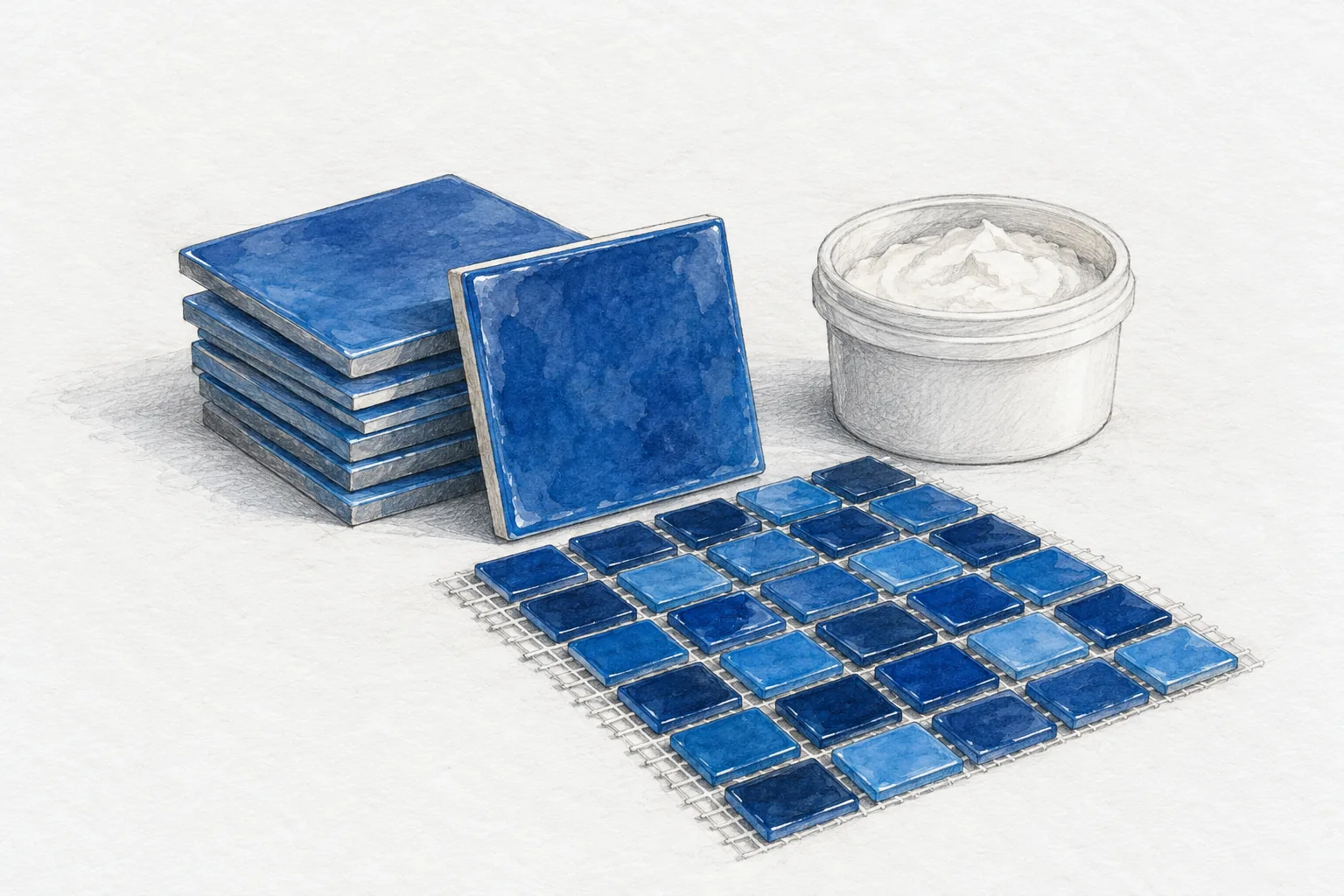
The LSDECO 20-piece porcelain waterline tile is the tile to start with for a waterline. It is a 6 inch by 6 inch glazed porcelain square, sold 20 pieces to a box for five square feet, with a listed water absorption under 0.5 percent. That low absorption is what makes it pool-rated: water cannot get in and freeze, so the tile does not crack the way a porous ceramic can.
The color in this box is a deep sapphire, and the glazed finish cleans easily. Porcelain is also dense enough that it shrugs off chlorine and salt without sealing. The catch is coverage. Five square feet per box is a small box, so measure the waterline, multiply by the band height, and buy a box or two extra for cuts and breakage.
Buy it if you want a durable waterline tile that wipes clean and stands up to a hard scrub. Skip it if you want an iridescent shimmer or you are tiling a curved corner, where the small format of a mosaic can flex and a 6x6 square cannot.
Best glass mosaic: LSDECO Cobalt Blue
The LSDECO cobalt glass mosaic is the pick for curves, rounded wall corners, and any waterline where you want the water to look deeper. It is a 12 inch by 12 inch mesh-mounted sheet of translucent glass, four millimeters thick, five sheets to a pack for five square feet. The mesh backing is what makes it work around bends, and it keeps the grout lines even from sheet to sheet.
Glass is the least porous pool tile, so it will not absorb water, stain, or fade from UV. The translucent face is also why the install asks for white thinset and a sandless grout: a gray thinset shows through and dulls the blue, and a coarse grout scratches the sheen. Handle it with a little more care than porcelain, and it will hold its look longer than anything else on the wall.
Buy it if you want a shimmering accent or you are covering a curved feature. Skip it if your water chemistry runs wild, because glass will show the first sign of scale.
Best grout repair: E-Z Patch 4 F.S.
The E-Z Patch 4 F.S. is the fix for the part of pool tile that actually fails. Tile rarely wears out. The grout between it cracks, washes out, or stains, and then water gets behind the tile. This is a white, fast-set, waterproof grout repair meant to refill those joints. You lower the water below the repair, clean out the loose grout, mix and pack the joint, and wipe it smooth with a damp sponge.
The fast-set label is the useful part. It cures hard in hours, not days, and the pool can go back to full the next day. That matters on an above ground pool, where you want to keep the water level up for wall stability. Match the color to your existing grout before you mix, and work in small batches, because a fast-set grout does not wait.
Buy it if you have cracked or missing grout at the waterline and the tile itself is sound. Skip it if tiles are loose or falling off, because that is a setting job, not a grouting job, and you need a pool tile thinset first.
Pool tile comparison
The three do different jobs, so the price per square foot is not a straight contest. Porcelain and glass cover the wall. The grout repair covers the joints. A waterline build usually needs tile and thinset together, not one or the other.
How much does pool tile cost?
Tile itself is the cheaper part of the job. Porcelain runs about $2 to $25 per square foot and glass about $8 to $50, before thinset, grout, and labor. Installed, porcelain lands near $8 to $25 per square foot and glass near $30 to $100, because glass needs careful setting and a white thinset.
Labor is what turns a few hundred dollars of tile into a bigger bill. On an above ground pool the band is smaller than a large in-ground rectangle, so the material cost stays modest, and a grout repair you do yourself is worth considering before a full re-tile. Measure the waterline with a tape, then divide by the coverage on the box to size the order.
How do you lay tile on an above ground pool?
The order matters more than the tools, and the rule that trips people up is color under glass. Keep the pool mostly full while you work, because an above ground wall leans on the weight of the water to stay straight.
- Lower the water a few inches below the work and let the wall dry.
- Remove any loose tile, old grout, and dust. The surface has to be sound.
- Spread a pool-rated thinset with a notched trowel, working in small sections.
- Set the tile or the mosaic sheet, keeping the joints even. Set glass sheets top face out.
- Let the thinset set, then grout the joints with a pool-rated grout.
- Wipe the grout with a damp sponge before it cures hard, then polish off the haze.
- Refill the pool after the grout cures, per the product's instructions.
What grout and thinset do pool tiles need?
Use a thinset rated for submerged use, and make it white under glass so the color stays true. For the joints, pick a pool-rated cement grout or an epoxy grout. Epoxy resists chlorine and salt better and lasts longer, but it is harder to spread and costs more. Standard cement grout is easier to work and cheaper, and it is fine as long as you keep the water balanced. Pack the joints full, because a shallow joint is where the next crack starts.
Does above ground pool tile need sealing?
No. Pool-rated glass and porcelain do not need sealer. They are non-porous, so there is nothing for a sealer to soak into and protect. Sealing is a stone job, because natural stone absorbs water and stains. If you use a plain cement grout, you can seal the grout lines, and that is worth doing in a saltwater pool where the salt works on the joints.
Do you have to seal grout in a saltwater pool?
You do not have to, but it helps. A standard cement grout is porous, and salt and chlorine wear it faster than they wear the tile. Seal the grout lines once a season, or skip the sealer and use an epoxy grout that resists both from the start.
Bottom line
Buy the LSDECO porcelain 6x6 for an above ground waterline that takes a scrub and wipes clean. Buy the LSDECO cobalt glass mosaic for curves, corners, and a waterline that shimmers in the sun. Buy E-Z Patch 4 F.S. when the tile is sound and the grout has failed.
Check that your pool has a rigid wall before you buy tile at all. A soft-sided pool will crack a tile band, and its printed liner border is the right finish for that pool. For a rigid wall, get the surface sound, use white thinset under glass, grout the joints full, and keep the water balanced. That combination is what keeps a waterline looking new after the first few summers.
Frequently Asked Questions
Can you put tile on an above ground pool?
Yes, if the pool has a rigid wall. A steel or resin above ground pool with a flat wall and a top rail can take a waterline tile band. A soft-sided pool flexes with the water and cracks a rigid tile bed, so it is not a tile job.
What type of tile is best for a pool?
For a waterline, porcelain and glass are the two pool-rated choices. Porcelain is dense, frost-resistant, and easy on the budget. Glass is non-porous, holds color longest, and catches the light. Both resist pool chemicals. Stone looks warm but needs sealing and stains more easily.
Is pool tiling expensive?
Waterline tile is the affordable part of pool work. Tile itself runs about $2 to $25 per square foot for porcelain and $8 to $50 for glass. Installed, porcelain lands near $8 to $25 per square foot and glass near $30 to $100. Labor is the larger share of the bill.
What is the tile on the edge of the pool called?
The band right at the waterline is waterline tile. On an in-ground pool, the piece on the top edge that you walk on is coping. On an above ground pool, the top rail takes that role and is not tiled.
Does above ground pool tile need sealing?
No. Pool-rated glass and porcelain are non-porous and do not need sealer. Natural stone does, because it absorbs water and stains. Seal the grout if you use a standard cement grout in a saltwater pool, or use epoxy grout instead.
What grout and thinset do pool tiles need?
Use a thinset rated for submerged use, and white thinset under any glass so the color does not turn muddy. For grout, use a pool-rated cement grout or an epoxy grout. Epoxy resists chlorine and salt better but is harder to work and costs more.
How do you lay tile around an above ground pool?
Keep the pool mostly full so the wall stays straight. Lower the water a few inches below the work, remove any loose tile and old grout, spread a thin coat of pool-rated thinset, and press the tile into place. Let it set, grout the joints, wipe with a damp sponge, and refill after the cure time.
How do you clean pool tile without scratching it?
Start with a soft brush and the least aggressive cleaner that lifts the film. Oily sunscreen rings come off with a tile cleaner and a light scrub. Calcium scale often needs a mild acid cleaner and a short dwell time before you brush. Avoid wire brushes on glazed tile.