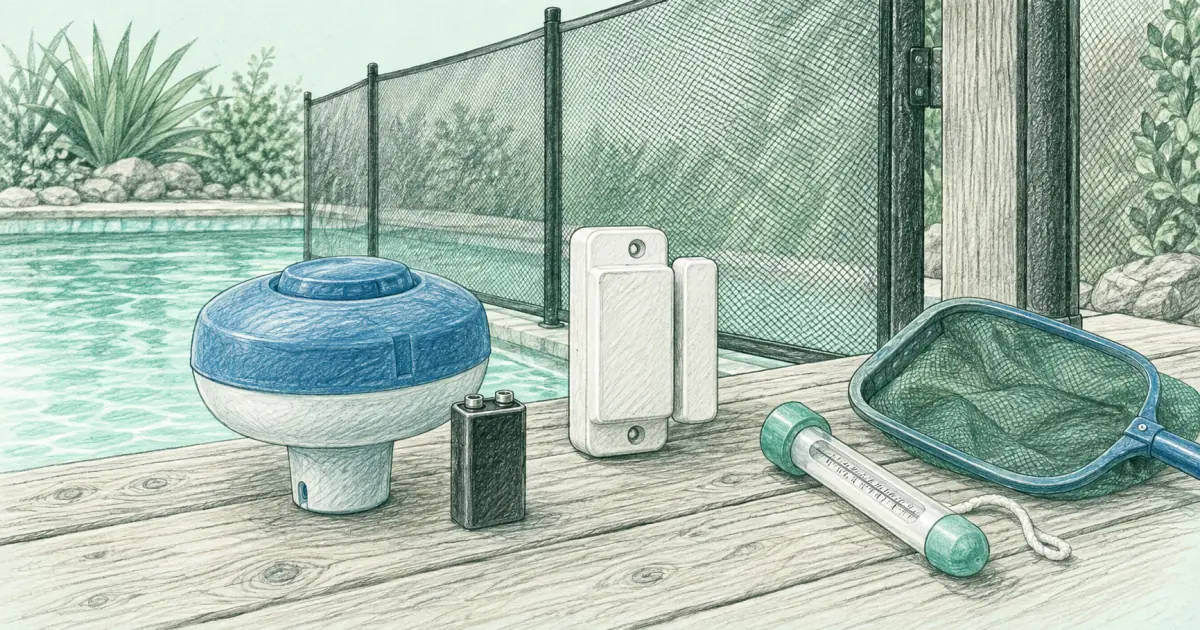
Pool Alarm (2026): Gate Sensor, In-Pool Floater, and Door Alarm Picks
Accessories
A pool alarm is one of the cheapest layers you can add to backyard child safety. A gate/door sensor covers the everyday exit, a floating in-pool alarm covers the surface, and the two together close most of the gap.
Our picks
A pool alarm is the cheapest second safety layer you can add to a backyard pool after a fence. A fence is the barrier. An alarm is the warning that buys you a few seconds between "where did the kid go" and "where is the kid in the water." Those seconds are where most backyard drownings happen, and an alarm closes that gap.
This page sits under pool accessories alongside the mesh pool fence and safety pool cover lanes. The fence is the open-season barrier. The cover is the closed-season barrier. The alarm is the layer that works when the others fail.
What a pool alarm actually does
A pool alarm watches a one and fires when that one changes. For a gate or door alarm, the one is a magnetic contact. When the gate opens, the contact breaks, and the siren fires. For a floating in-pool alarm, the one is the water surface. When something disturbs the water above a set threshold, the siren fires.
Neither replaces adult supervision. Both add seconds of warning when a child or pet reaches the water without an adult seeing it happen. Those seconds are what the alarm buys you.
An alarm does not stop a fall. A fence stops a fall. A cover stops a fall. An alarm tells you a fall is happening so you can respond before it becomes an outcome.
Three pool alarm jobs, three different picks
The category splits into three jobs that share a name but cover different surfaces. Pairing the right job to the right product is the entire buying decision.
A gate or door sensor alarm mounts on a fence gate, back door, or slider leading to the pool. It fires when the contact opens. This is the everyday entry point, and a single UL 2017 sensor covers it.
A floating in-pool alarm sits on the water. It fires when something disturbs the surface above a set sensitivity. This catches anything that bypasses the fence (a ball, a pet, a toddler who climbed over). ASTM F2208 is the certification to look for.
A gate-mount alarm with remote mounts on a fence or shed opening and pairs with a handheld remote for adult bypass. The 2-pack versions cover a fence gate plus a service door at lower cost.
The realistic answer for most backyards is one of each.
Hero pick: Techko S187D Safe Pool Alarm
The Techko S187D Safe Pool Alarm is the strongest single-unit pick for the back door or slider leading to the pool. It is UL 2017 compliant, which is the certification most local child safety laws reference. The siren runs 110 to 115 dB at the source, which is loud enough to hear through a closed door and over a TV.
Two bypass buttons on the unit let an adult walk out for ten seconds without disabling the alarm. The screen door sensor keeps a slider open without firing the alarm, which matters on a hot evening when the slider stays cracked.
One S187D covers one opening. A back door plus a fence gate is two units. The 9V battery is not included in the box, so add one to the order. Owners report 6 to 12 months of normal use per battery.
If your home only has one path to the pool, this is the single right pick. If you have two paths, pair it with a second S187D or a 2-pack gate alarm at the secondary opening.
In-pool backup: Hovara Floating Pool Safety Alarm
The Hovara Floating Pool Safety Alarm is the strongest pick when you want a sensor on the water itself. It sits on the surface, fires at 110 dB when something disturbs the water above the set sensitivity, and runs on a single 9V battery that ships in the box.
Adjustable sensitivity is the useful control. Wind, rain, and waves cause false alarms on a fixed-sensitivity unit. Turn the dial down for stormy weather and back up for calm days. Most owners settle on a middle setting and forget it.
The Hovara fits inground and above-ground pools up to 20 by 40 feet. For larger pools, place the unit in the middle of the longest run, away from skimmers, return jets, and waterfalls. Strong water movement is the main source of false alarms.
The honest limit: a floating alarm covers the water, not the gate. A child who opens the gate, walks past the deck, and falls in still fires the alarm, but a child who opens the gate and gets caught at the door does not. Pair the float with a door or gate sensor for the full coverage.
Cheaper gate mount: Hendun 2-pack with remote
The Hendun Pool Gate Alarm Outdoor with Remote, 2 Pack is the budget answer when you need to cover two openings (a fence gate and a shed, or a side gate and a porch door) for one price. The siren runs 140 dB, the housing is IP67 waterproof, and a small handheld remote bypasses the alarm for adult exits.
The 2-pack ships with the two sensors, mounting hardware, and a remote. The remote is the useful detail. An adult walks through the gate, taps the remote, the alarm stays silent for the entry, and re-arms when the gate closes.
The honest limit is certification. The listing does not show UL 2017 or ASTM F2208. For a US backyard where local code requires a certified alarm, the Techko S187D or a Poolguard unit is the safer choice. For a fence gate on a property where code does not require a certified alarm, the Hendun is a strong value.
Pair alarms with a fence and a cover
An alarm is a layer, not a system. The realistic safety stack for most backyard in-ground pools runs three deep.
The first layer is a mesh pool fence. Four-foot aluminum poles in deck sleeves, mesh panels that lift off in minutes. This keeps a child or pet from reaching the water in the first place.
The second layer is an alarm. A door sensor for the everyday entry, a floating sensor for the water surface. This adds seconds of warning if the fence is left open, or if the child climbed over.
The third layer is a safety pool cover. Brass anchors in the deck, stainless springs, mesh that supports weight. This is the closed-season barrier that protects the pool when nobody is swimming.
Most safety inspectors and pediatricians agree the three-layer approach is the realistic minimum for a backyard with small children. The alarm alone is not enough. The fence alone is not enough. The three together are the practical answer.
Where the alarm will and will not work
Pool alarms work on any pool that has a defined opening and a water surface. That covers most inground and above-ground residential pools in the US.
They do not work well on a pool that runs heavy water features. A pool with a continuous waterfall, a deck jet array, or a strong negative-edge flow will false-trigger any floating alarm on the market. The fix is a different product (a subsurface alarm) or a different pool layout.
They do not work well on an above-ground pool with no deck. If the only entry to the water is a fold-up ladder that adults can lift, the ladder is the layer. An alarm on a wall door and a floating alarm on the water still help, but the ladder is what stops the climb.
They do not work in frozen water. Most floats shut off or lose sensitivity below about 50 degrees. Pull the alarm, dry it, and store it with the battery out for winter. Reinstall when the pool opens again.
What to skip
Skip a "pool alarm" with no certification. Plenty of cheap door chimes are sold as pool alarms. They fire when the door opens, which is fine, but they are not UL 2017 or ASTM F2208 certified and most local inspectors will not count them toward code.
Skip a single sensor that covers the whole pool. No floating alarm ignores heavy water movement. No door alarm catches a fall from outside the fence. The job needs two units, not one.
Skip the smart-only alarms if you have no working home network. An app that needs Wi-Fi and a battery and a phone to fire is not a pool alarm. A loud siren that fires when the contact opens is.
Where the alarm meets the rest of the safety kit
A working pool safety kit runs alarm plus fence plus cover, with a test kit and a pool cover pump on standby. A typical layout looks like this.
When the pool is open, the fence is up, the door alarm is armed, the floating alarm is in the water, and a pool test kit sits on the deck. A pool skimmer clears the daily debris and an adult watches any child in or near the water.
When the pool is closed, the fence rolls up and stores in a garage, the floating alarm comes out and stores indoors, the door alarm stays in place, and a safety pool cover goes on the water. The cover pump is for any rain that lands on a solid cover.
When the pool is between seasons, the door alarm is on bypass during heavy yard work, the floating alarm is dry and stored, and the fence is in storage. Bring everything back online at the spring opening.
How long a pool alarm lasts
A UL-listed door alarm with a hard plastic housing typically lasts 5 to 10 years before the contact switch wears out. A floating alarm with a sealed housing typically lasts 3 to 6 seasons of full sun and freeze-thaw before the battery compartment or the sensor fails.
The two wear parts are the 9V battery (every 6 to 12 months) and the magnetic contact on a door or gate alarm (every 2 to 4 years in a high-traffic opening). Replace the battery every swim season. Replace the contact when the alarm starts false-firing or stops firing on a real opening.
If the alarm is more than 8 years old, replace the whole unit. Newer units are louder, smarter, and easier to mount than older units. A $25 to $50 replacement is cheaper than the risk of a worn-out sensor that does not fire.
Common mistakes that waste the alarm
Mounting the contact too low. The sensor should sit at adult-shoulder height, around 60 inches from the floor. A toddler can reach a contact mounted at 36 inches.
Floating the alarm near a return jet. Strong water movement false-triggers most floats. Move the unit to the middle of the longest pool dimension, away from skimmers, waterfalls, and pumps.
Leaving the bypass engaged. The Techko bypass is a 10-second tap, not a toggle. A switch left in bypass is an alarm that does not fire. Check the indicator light at the end of every swim day.
Skipping the battery. A dead 9V at the start of swim season is a common reason alarms fail to fire. Replace the battery when the pool opens and again when it closes.
Buying one alarm for two openings. One unit covers one opening. If you have a back door and a fence gate, you need two units or a 2-pack at the gate.
Who should skip a pool alarm
If your pool is already inside a permanent aluminum or chain link fence with a self-closing, self-latching gate at every opening, and your local code does not require an alarm, the alarm is a redundant layer. Keep the fence in good repair and skip the alarm.
If the deck around the pool is enclosed by a four-sided mesh pool fence with a self-closing gate, and the house door to the pool is locked or alarmed by a home security system, the additional alarm adds little. The mesh fence is the layer.
If you have no children or pets visiting the yard and no local code requirement, the alarm is optional. Adult supervision and a working fence are enough.
Bottom line
The Techko S187D Safe Pool Alarm is the strongest single pick for the everyday back door or slider because it is UL 2017 compliant, loud, and has a screen door sensor. Pair it with the Hovara Floating Pool Safety Alarm for a sensor on the water and a Hendun Pool Gate Alarm 2-Pack for a fence gate or service door.
Pick the Techko alone if your home has one path to the pool. Pick the Techko plus the Hovara if you want both layers. Pick the Hendun 2-pack when you need to cover two openings on a budget and your code allows a non-UL sensor.
An alarm is one layer. The full kit is a mesh pool fence plus an alarm plus a safety pool cover. All three are out of the way when you do not need them.
Frequently Asked Questions
Do pool alarms really work?
Yes, when they are UL 2017 or ASTM F2208 certified. A pool alarm adds seconds of warning between a child or pet reaching the water and you hearing it, which is the gap most drownings happen in. They do not replace adult supervision or a fence, but they are the cheapest extra layer you can add to almost any backyard pool.
What is the best type of pool alarm?
A combination is the realistic answer. A gate or door sensor catches the everyday entry point. A floating surface sensor catches anything that bypasses the fence (a ball, a pet, a toddler who climbed over). UL 2017 covers door and gate alarms. ASTM F2208 covers floating in-pool alarms. Many safety codes accept either or both.
Where should a pool alarm be placed?
Mount the gate or door sensor on every opening that leads to the pool, with the contact at adult-shoulder height so a toddler cannot reach it. Float the in-pool alarm in the middle of the longest dimension, never in front of a return jet, waterfall, or pump outlet. Strong water movement causes false alarms.
Do I need a pool alarm if I have a fence?
Most local codes require a fence. Most safety organizations still recommend an alarm as the second layer, because fences fail. A gate gets left open. A mesh panel pops out. A child climbs. The alarm is the layer that buys you a few seconds of warning in those cases.
How loud does a pool alarm need to be?
100 dB or higher at the source is the realistic floor. 110 dB or more is the common residential target. You need to hear it over a closed window, the TV, the AC, and the kids inside. If you cannot hear a test from the deepest part of the house, the alarm is too quiet for your layout.
What about above ground pools?
Yes, alarms fit above-ground pools too. Look for a floating model that is rated for soft-sided and steel-walled pools, and a door alarm for the deck or porch entry. Ladders that adults can fold up are the cheapest layer above all, but they fail when someone forgets to fold them.
Will a pool alarm false-trigger in wind?
Floating alarms can. Cut false triggers by turning the sensitivity down for windy days and by moving the alarm away from waterfalls, return jets, and skimmers. Door and gate alarms rarely false-trigger because they only fire when the contact opens.
How long does the battery last?
Most pool alarms run on a single 9V battery for 6 to 12 months of normal use. The Techko S187D uses a 9V (not included). The Hovara float ships with a 9V. Either way, change the battery at the start of swim season and again at the end. A chirp or LED indicator is the universal low-battery signal.
Do pool alarms meet local child safety laws?
Many states and cities require alarms on specific openings, especially for new pools or for households with children under a certain age. Check your local code before you buy. UL 2017 door and gate alarms and ASTM F2208 floating alarms are the two certifications inspectors usually accept.
Can a pool alarm fail in cold water?
Yes. Most floating alarms lose sensitivity below about 50 degrees and some shut off entirely to save the battery. If you keep the pool open through winter or close it cold, pull the alarm out, dry it, and store it with the battery removed. Reinstall at the start of the next swim season.
Do I need more than one alarm?
For most backyard pools, yes. One unit per opening plus one float on the water is the realistic minimum. Larger pools or pools with more than one entry point scale up from there. A 2-pack gate alarm covers a fence gate and a shed door in one order.
Are smart pool alarms worth it?
Smart alarms (app alerts, Wi-Fi, Alexa) are useful when you cannot hear a siren from inside the house or when you travel. They cost more and need a working home network. For most owners, a loud UL-listed alarm plus a float covers the realistic need.