Pool Safety Fence (2026): DIY Mesh Picks + Full Perimeter Kits
Accessories
A pool safety fence adds a climb-resistant barrier around an in-ground pool. 12-foot Life Saver sections fit irregular perimeters; 108-foot VEVOR kits cover a typical 16 by 32 pool out of the box. Pair with a self-closing gate to finish the system.
Our picks
A pool safety fence is the perimeter barrier that keeps kids and pets from reaching the water. Removable mesh sections drop into deck sleeves, lift out for off-season storage, and roll up in minutes. Most safety codes accept a 4-foot mesh fence with a self-closing gate as the residential barrier layer.
This page sits under pool accessories alongside the mesh pool fence guide. The mesh pool fence guide compares premium pre-assembled 15-foot panels like ALLSAFE and WaterWarden. This page is the broader lane: 12-foot pre-assembled sections, full-perimeter kits, and the gate hardware needed to finish the system.
What a pool safety fence actually does
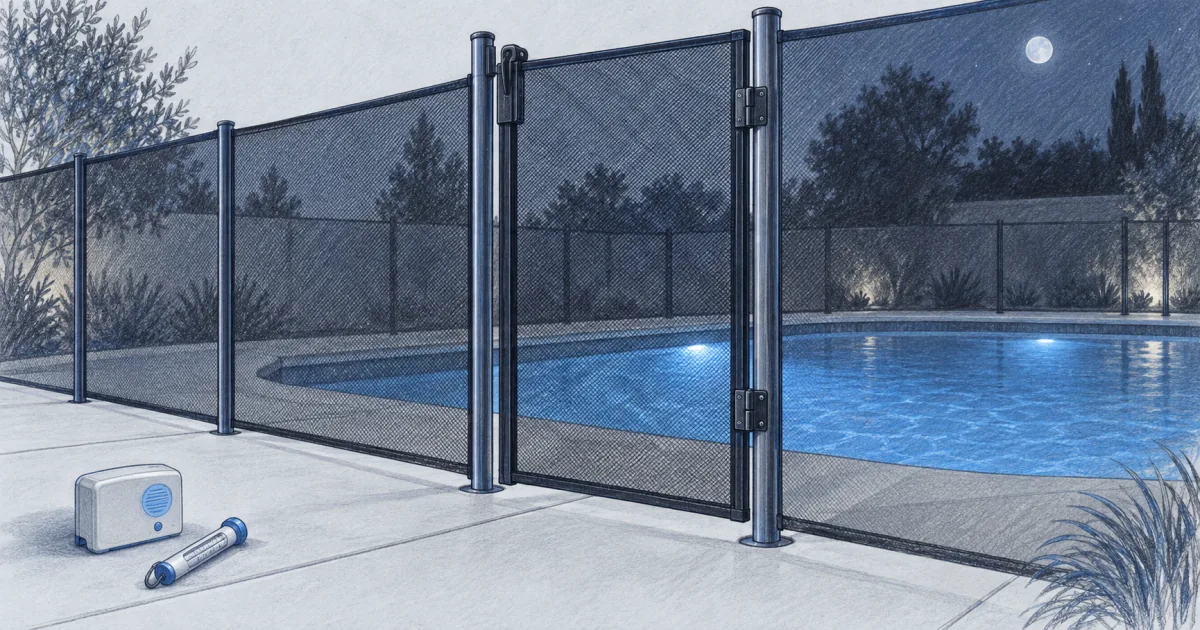
A pool safety fence gives a climb-resistant perimeter that adults can remove in minutes. The poles anchor into the deck so the fence does not move when pushed. The mesh weave is climb-resistant for small hands and feet, but the panels lift out of the sleeves and roll up when you want the pool open for entertaining.
The fence does not replace adult supervision. It adds a layer of protection for the minutes between "where is the kid" and "where did the kid go." That gap is where most pool accidents happen, and a fence closes it.
It also does not support weight. A child leaning against the mesh is contained, but the fence is not a deck or a floor. For weight support across the water, you want a separate safety pool cover. The two products do different jobs.
Pool safety fence versus permanent fence versus safety cover
The three common pool safety products get confused because they all "fence" or "cover" the pool.
A mesh pool safety fence (this page) is a removable perimeter barrier with aluminum or stainless poles and mesh panels. For the swim season when the pool is open. Rolls up for storage.
A chain link or aluminum fence is a permanent structure with footers and hardware that stays in place year round. Costs more and adds real estate value, but does not roll up.
A safety pool cover is a deck-anchor sheet that covers the water surface and supports weight when the pool is closed. For the off-season.
A mesh safety fence plus a safety cover is the most complete system for in-ground pools with small children or pets. The fence is up during swim season, the cover goes on when the pool is closed, both products stay out of the way when you do not need them.
Hero pick: Life Saver DIY Section Kit
The Life Saver Pool Fence DIY Section Kit, 4 x 12-Feet, Black is the strongest DIY section for irregular pool shapes and tight runs. Each panel is pre-assembled at 4 feet tall and 12 feet long, with five integrated aluminum posts, brass safety latches, and a drilling template.
The 12-foot panel is the useful detail. Where 15-foot pre-assembled panels run straight and need open space, a 12-foot panel turns tighter corners and fits narrow runs between a pool and a house wall. The trade is more poles and more drill holes per perimeter.
Life Saver mesh is Textilene PVC-coated nylon with a strength rating of over 270 pounds per square inch. The mesh is UV-protected and the aluminum posts are heavy gauge. Owners report 8 to 12 years of service before the mesh ages.
The honest limit is the deck surface. Life Saver ships with sleeves sized for concrete or paver decks. Grass and dirt installs need longer PVC sleeves set in concrete footings, which is a different project. Most DIY owners skip the grass install and put the fence on the existing deck that wraps the pool.
Full-perimeter pick: VEVOR 4 x 10⁸ FT kit
The VEVOR Pool Fence, 4 x 10⁸ FT is the strongest pick when you want one order to cover a full perimeter. The kit ships 108 feet of 4-foot mesh in 12-foot sections, Teslin PVC mesh fabric, stainless steel legs, and aluminum poles.
The 108-foot kit fits a typical 16 by 32 in-ground pool out of the box. Most backyard perimeters run 100 to 120 feet including deck margin, so a 108-foot kit usually lands at or near the right total without buying extras.
Teslin PVC mesh is heavier than Textilene (340 grams per square meter) and the triple-needle stitching adds tear strength. The mesh is waterproof, oil-resistant, and acid-alkali-resistant, which matters in a deck environment where sunscreen, chlorine splash, and patio food spills are daily realities.
The honest limit is brand polish. VEVOR is a value brand and the installation instructions assume you have done a fence install before. Dry-fit the sections before you drill, mark the pole locations with a chalk line, and check the gate location before you cut any sleeves.
Gate kit: Life Saver Self-Closing Gate
The Life Saver Pool Fence DIY Self-Closing Gate Kit, Black is the matching gate for the section kit. The gate uses a MagnaLatch top-pull latch and TruClose self-closing hinges, both pool-industry standards for child-resistant closures.
The MagnaLatch latches at the top of the gate, away from small hands. The TruClose hinges shut the gate from any open angle, not just from fully open. The double-truss uprights hold the gate square across a 36-inch opening.
The honest limit is matching brands. The gate kit is built to mate with Life Saver sections. Pairing it with a different brand's section kit usually leaves a gap at the latch geometry and a weak point in the system. Buy both from Life Saver if you start with Life Saver panels.
Self-closing gate is mandatory
A pool safety fence without a self-closing, self-latching gate is not a complete safety system. The gate is the only legal way through the fence in most jurisdictions, and it is the most common failure point on cheap installs.
Buy the gate from the same maker as the panels. Life Saver sells the self-closing gate that pairs with their section kit. Aftermarket gates from a different maker rarely align with the panel latch hardware and rarely self-close from a partial-open position.
The gate should swing outward, away from the pool. The latch should be at the top of the gate so a toddler cannot reach it. The self-closing hinge should shut the gate from any open angle, not just from fully open.
If the gate fails the push-test (open it partway and let go, it should close and latch on its own), the hinge spring is too weak or the latch is misaligned. Fix that before you trust the system.
How tall and how long
The standard residential pool safety fence is 4 feet tall and comes in 12-foot or 15-foot sections. A 4-foot fence is climb-resistant for most toddlers and meets ASTM F2286 for residential pools.
A 5-foot fence is the right answer when local codes ask for it, when you have an older toddler who can already climb a 4-foot fence, or when the pool is in a yard that gets daily supervision lapses.
Perimeter length depends on pool size and the deck you want to fence. Measure the deck edge you want to enclose, then add about 10% for trim cuts and a gate opening. A 16 by 32 in-ground pool usually wants about 100 to 120 feet of perimeter including the deck margin.
Where the fence will and will not work
Pool safety fences are for in-ground pools with a concrete, paver, or wood deck around them. The deck sleeves need a solid surface to anchor into.
The fence does not work on grass or dirt without extra footing work. It does not work on above ground pools because the deck edge sits above grade. For above ground pools, the safety story is different. A removable pool alarm plus adult supervision plus a solid winter cover is the realistic layer.
The fence does not work as a winter cover. Do not tension mesh and leave it under snow load. Pull the panels out, roll them up, and store them indoors for the off-season.
Where the fence meets the rest of the safety kit
A pool safety fence is one piece of a working pool-safety system. Pair it with the rest of the kit.
When the pool is open, the mesh fence is up, the pool is filtered, the water is balanced, and a pool test kit sits on the deck. A pool skimmer is in the water for leaves and a pool alarm watches the gate. An adult is supervising any child in or near the pool.
When the pool is closed, a safety pool cover goes on the water, the mesh fence rolls up and stores in the garage, and a pool cover pump is on standby for rain that lands on the cover.
When the pool is between seasons, the cover is on, the fence is stored, the filter is drained or winterized, and the gate hardware sits in a dry bag in the garage for spring reinstall.
How long a pool safety fence lasts
A UV-protected mesh with aluminum or stainless poles typically lasts 8 to 12 years with reasonable care. The mesh is the part that ages first, and full sun during storage is what fades it.
Roll the fence up and store it out of direct sun during the off-season and the mesh will hold its color and weave for many seasons. The poles age slower. Stainless steel pegs and aluminum poles do not rust in normal pool-deck conditions.
If the fence has been up year round for 10+ years, plan a replacement rather than a repair. The mesh weave loses strength as it ages, and a fence that survives a toddler push at year 2 may not survive the same push at year 12.
Common mistakes that waste the fence
Installing on the wrong surface. Grass and dirt need a different sleeve system. Most DIY homeowners skip the grass install and fence the deck that already wraps the pool.
Using the wrong gate. A non-self-closing gate defeats the safety system. Buy the matching gate from the fence maker.
Skipping the trim. Pre-assembled panels are easy to cut, but a straight cut with the included trim strip keeps the mesh from unraveling. Pull-cut mesh looks fine on day one and unravels by spring.
Forgetting the removal plan. A mesh fence that nobody rolls up stays up year round. That ages the mesh faster than anything else. Roll it up in October, store it in a garage or shed, and reinstall in May.
Over-tensioning the mesh. Tight mesh looks neat but it stresses the poles and the deck sleeves. Leave a small bow in each panel so wind has somewhere to flex.
Bottom line
The Life Saver Pool Fence DIY Section Kit is the strongest pool safety fence section for irregular pool shapes and tight runs because the 12-foot panels fit where longer panels would not. For a full perimeter out of one box, the VEVOR Pool Fence 4 x 10⁸ FT kit covers a typical 16 by 32 in-ground pool. Pair either with the Life Saver Self-Closing Gate Kit to finish the system.
Pick the Life Saver section kit when you have an irregular pool shape and want premium DIY mesh. Pick the VEVOR full-perimeter kit when you want one box to cover the whole pool. Pair both with a Life Saver self-closing gate for a finished system.
A pool safety fence is for the swim season. Add a safety pool cover for the closed season and the system is complete. For a tighter comparison of premium 15-foot pre-assembled panels, see our mesh pool fence guide.
Frequently Asked Questions
How much does a pool safety fence cost?
A DIY mesh pool safety fence usually costs about $15 to $20 per linear foot for the sections, plus a self-closing gate kit that runs around $300 to $500. A 100-foot pool perimeter with one gate lands near $2,000 to $2,500 in materials for a quality DIY install. Full-perimeter multi-section kits run about the same total. Professional installation runs higher because the crew drills sleeves and tensions the mesh for you.
Are pool safety fences safe?
Yes, when they meet ASTM F2286 (mesh) or local barrier codes. The mesh weave is climb-resistant for toddlers, and the poles anchor into the deck so the fence stays in place when pushed. A safety fence is a barrier layer, not a substitute for adult supervision, but it adds real protection compared with an open pool deck.
Which pool safety fence is best?
For DIY in-ground installs, Life Saver and VEVOR are the strongest picks. Life Saver ships pre-assembled 12-foot panels with Textilene mesh and brass safety latches. VEVOR ships a 108-foot kit with Teslin PVC mesh, stainless legs, and aluminum poles for one full perimeter order. Pair either with a self-closing gate kit.
How tall should a pool safety fence be?
Four feet is the standard for residential pools and matches ASTM F2286 and the US Consumer Product Safety Commission recommendation. Five-foot panels are common for households with active toddlers or local codes that ask for extra height. Either height works for child safety as long as the fence is certified and the gate self-closes.
Do I need a gate on a pool safety fence?
Yes. A self-closing, self-latching gate is the only legal way through the fence in most jurisdictions, and it is the most common failure point on cheap installs. Buy the matching gate kit from the same maker as the fence. Life Saver sells a self-closing gate that pairs with their section kit. Pairing two different brands usually leaves gaps in the latch geometry.
Can a pool safety fence go on grass or dirt?
The included sleeves are designed for concrete or paver decks. For grass or dirt installs, you need longer PVC sleeves set in concrete footings, which is a different project. Most DIY homeowners skip the grass install and put the fence on the deck or walkway that already surrounds the pool.
How long does a pool safety fence last?
A UV-protected mesh with aluminum or stainless poles typically lasts 8 to 12 years with reasonable care. Fading and brittleness come from full-sun storage, not from the fence being up. Roll the fence up and store it out of direct sun during the off-season and the mesh will hold its color and weave for years.
What is the difference between a pool safety fence and a mesh pool fence?
Functionally, nothing. Both are removable mesh pool fences with aluminum poles and deck sleeves. The terms are used interchangeably by retailers. The differences between products are panel length, mesh weight, pole material, and gate hardware. For a tighter comparison of premium 15-foot and 12-foot pre-assembled panels, see our mesh pool fence guide.
Can a pool safety fence be removed easily?
Yes. The poles lift out of the deck sleeves, and the mesh rolls up. Most homeowners remove the fence for winter and reinstall it for swim season. The whole process takes about an hour for a typical 100-foot perimeter with one adult and a socket wrench.
Is a pool safety fence the same as a safety pool cover?
No. A pool safety fence is a perimeter barrier that keeps kids and pets from reaching the water. A safety pool cover is a deck-anchor sheet that sits on top of the water and supports weight when the pool is closed. They do different jobs. For full protection, many owners add both: a fence when the pool is open and a cover when the pool is closed.
How many sections do I need?
Measure the deck edge you want to enclose and add about 10% for trim cuts and a gate opening. A 16 by 32 in-ground pool usually wants 100 to 120 feet of perimeter including the deck margin. Divide by 12 to get the number of sections (8 to 10 for a typical pool).
Will the fence affect my pool cleaner?
Most robotic and suction cleaners work fine inside a mesh fence. The cleaner stays on the deck side of the fence and works the water from there. For a cleaner that needs to cross the deck to reach a skimmer, plan a service opening or remove a panel weekly.